

Acid vs. Alkaline Foods: What the Difference Really Means
The difference between “acid” and “alkaline” foods has nothing to do with how a food tastes or its pH before you eat it. It refers to the metabolic residue, called ash, that food leaves behind after digestion, measured by something called Potential Renal Acid Load, or PRAL. Eating more plant foods shifts that ash toward alkaline, but it changes your urine pH, not your blood.
- Blood pH stays fixed between 7.35 and 7.45 in healthy people, no matter what you eat.
- Urine pH moves with your diet within hours.
- The practical move: build meals around vegetables, fruits, and legumes, and treat animal proteins and processed foods as the acid-forming minority on your plate.
Quick fact: Healthy kidneys and lungs keep blood pH inside that narrow 7.35 to 7.45 window regardless of diet, according to Baylor College of Medicine. No food, juice, or supplement pushes it higher.
Key Takeaways
The core distinction is metabolic, not culinary: acid and alkaline foods are classified by PRAL, the acid or alkaline residue left after digestion, not by taste or pre-eating pH.
| Point | Details |
|---|---|
| Classification is metabolic | Foods are labeled acid- or alkaline-forming based on PRAL, the ash left after digestion, not raw pH. |
| Blood pH stays fixed | Healthy blood pH stays between 7.35 and 7.45; only urine pH shifts with diet. |
| Plant-forward wins on evidence | Diets emphasizing vegetables, fruits, and legumes show real links to lower kidney stone risk and better diet quality. |
| Kidney disease requires caution | People with chronic kidney disease should adjust dietary acid load only under a clinician’s supervision. |
| Alkaherbs supports the pattern | Alkaherbs’ mineral-rich herbs and sea moss can complement a plant-forward diet without replacing medical care. |
Table of Contents
- What Is the Difference Between Acid and Alkaline Foods?
- Common Alkaline-Forming and Acid-Forming Foods
- What Happens Inside Your Body: Urine vs. Blood pH
- What the Research Actually Shows About Health Outcomes
- How to Balance Your Acid-Alkaline Diet Without Nutrient Gaps
- How to Test Your Body’s pH at Home (and What It Actually Tells You)
- Who Should Be Cautious With an Alkaline-Focused Diet
- Where Mineral-Rich Herbs Fit Into a Plant-Forward Approach
- Why “Alkaline” Is the Wrong Word, but the Right Instinct
- Complementing Your Plant-Forward Plate With Mineral-Rich Herbs
- Frequently Asked Questions
- Sources
What Is the Difference Between Acid and Alkaline Foods?
Here’s where a lot of confusion starts. Lemons taste acidic, but they’re classified as alkaline-forming. That seems backward until you understand what’s actually being measured.
A food’s pH before you eat it tells you almost nothing about its effect on your body. What matters is what’s left over after your body metabolizes it, the “ash.” Researchers use PRAL to quantify this: it’s a calculation based on the protein, phosphorus, potassium, calcium, and magnesium content of a food, and it estimates whether that food will leave an acidic or alkaline residue for your kidneys to process, according to PRAL research on dietary acid load.
Nutrients don’t all pull in the same direction. Protein, sulfur compounds, and phosphate tend to generate acidic ash. Calcium, potassium, and magnesium tend to generate alkaline ash. That’s the entire mechanism behind why a steak and a bowl of spinach get sorted into opposite categories, even though both start out roughly neutral to your tongue.
- Acid-forming nutrients: protein, sulfur-containing amino acids, phosphate.
- Alkaline-forming nutrients: calcium, potassium, magnesium.
- Neutral: natural fats, starches, and sugars generally don’t tip the scale much either way.
Pro Tip: Don’t bother testing a food’s raw pH with a strip before you eat it. It won’t predict its metabolic effect. If you want precision, look up its PRAL value instead, which is why nutrition researchers rely on it rather than pH readings.
Common Alkaline-Forming and Acid-Forming Foods
Knowing the categories is one thing. Knowing what to put in your cart is another. Alkaline-forming foods, acid-forming foods, and a handful of exceptions that trip people up.
- Non-starchy vegetables like leafy greens, broccoli, and peppers sit at the top of the alkaline-forming list.
- Most fruits, including citrus, are alkaline-forming despite their tart, acidic taste, according to Healthline’s evidence-based review.
- Legumes such as lentils and chickpeas contribute alkaline ash while also delivering plant protein.
- Certain nuts and seeds, almonds especially, lean alkaline-forming compared to most other protein sources.
- Quinoa stands out among grains as one of the few that’s alkaline-forming rather than acid-forming.
On the acid-forming side, the pattern is fairly consistent: meat, poultry, dairy, eggs, and most grains all fall here, per the same Healthline review. Processed foods, cured meats, and hard cheeses tend to rank even higher in acid load than their whole-food counterparts, since processing often concentrates sodium and phosphate additives.
A few foods don’t behave the way you’d guess. Citrus fruits are the classic example, acidic to taste, alkaline-forming metabolically. Some starchy vegetables like potatoes also skew more acid-forming than people expect once you account for their nutrient profile.
A short starter list if you’re shopping today:
- Alkaline side of the cart: spinach, kale, cucumber, avocado, lentils, almonds, watermelon, quinoa.
- Acid side of the cart: chicken breast, aged cheddar, deli meat, white bread, eggs.
What Happens Inside Your Body: Urine vs. Blood pH
Your blood pH sits in a range so narrow that a shift of even a few tenths outside 7.35 to 7.45 signals a medical emergency, not a dietary phase. Your lungs and kidneys manage that range continuously, adjusting carbon dioxide exhalation and bicarbonate excretion in real time, according to Baylor College of Medicine’s review of alkaline diet claims.
Urine is a different story. It’s designed to be a waste channel, so its pH swings with whatever your kidneys are filtering out that day. Eat a big plate of leafy greens and your urine tends to trend more alkaline within hours. Eat a burger and fries and it shifts acidic. That responsiveness is exactly why urine pH makes a poor stand-in for “how alkaline my body is” as a whole. It reflects excretion, not systemic status.
- Blood pH: fixed, 7.35 to 7.45, regulated by lungs and kidneys.
- Urine pH: variable, shifts with diet within hours, not a marker of overall health.
- Metabolic acidosis: a real medical condition where blood pH drops too low, usually tied to kidney dysfunction, uncontrolled diabetes, or severe illness, not to eating too much acid-forming food.
Review literature on acid-base balance backs this distinction consistently: healthy kidneys compensate for dietary acid load without measurable changes to blood chemistry. If a doctor ever tells you that you have metabolic acidosis, that’s a clinical finding requiring medical management, not something a green smoothie caused or a green smoothie will fix.
What the Research Actually Shows About Health Outcomes
Some benefits linked to alkaline-forming eating patterns are real. Others are marketing dressed up as biology. Worth separating the two.

Diets higher in alkaline-forming foods are associated with a lower risk of kidney stones, and there’s a reasonable case for benefits to bone and muscle preservation, largely because these diets tend to replace processed, calorie-dense foods with produce, according to an overview from AANMC’s naturopathic kitchen resource. That’s a meaningful, evidence-backed outcome.
Here’s the part that gets overstated:
There’s no credible evidence that any diet can shift blood pH in a healthy person, and claims that alkaline foods “starve” cancer cells or cure disease by altering body pH aren’t supported by clinical research. Medical News Today’s review states plainly that alkaline diets do not raise blood pH, even though they can improve health markers by improving overall diet quality.
The mechanism matters here. Much of the observed benefit likely comes from what an alkaline-forming pattern displaces, less processed meat, less added sugar, more fiber, rather than any direct chemical alkalization of tissue.
- Kidney stones: lower risk with reduced dietary acid load, reasonably well supported.
- Bone and muscle: plausible support tied to displacing processed foods, not to “neutralizing acid.”
- Cancer or disease cures via pH change: not supported by clinical evidence.
- People with chronic kidney disease: this is the group most likely to see clinically meaningful benefit from acid-load adjustments, but only under a clinician’s guidance.
How to Balance Your Acid-Alkaline Diet Without Nutrient Gaps
You don’t need a lab manual to eat this way sensibly. You need a plate ratio and a short list of substitutions.
- Start with the plate, not the pantry. Fill much of your plate with vegetables, fruits, and legumes, and leave a smaller portion for animal protein or grains. This ratio is a helpful guideline, not a strict rule.
- Cut processed foods before you cut whole foods. Deli meat, packaged snacks, and soda carry a heavier acid load than an equivalent portion of fresh meat or dairy, so trim those first.
- Use PRAL tables if you want precision. Skip the pH strips on your food; they measure the wrong thing. A published PRAL list tells you the actual metabolic acid load per food.
- Protect your protein and iron intake. Swap in lentils, beans, tofu, and nuts alongside, not instead of, moderate portions of meat or fish so you’re not quietly shorting yourself on iron and B12.
- Keep calcium sources visible. Leafy greens, almonds, and fortified plant milks can cover calcium needs as you shift the ratio toward plant-forward eating.
Pro Tip: Track your plate visually for a week before you track any numbers. Most people overestimate how “plant-forward” their meals already are until they actually look.
For a deeper shopping reference, Alkaherbs’ anti-inflammatory alkaline foods list breaks down specific swaps by meal type.
How to Test Your Body’s pH at Home (and What It Actually Tells You)
Urine or saliva pH strips can show you a real, short-term signal: whether your last meal or two skewed acid-forming or alkaline-forming. That’s it. It’s not a systemic health score.
- Test first-morning urine for consistency, and repeat over a few days rather than relying on one reading.
- Typical urine pH ranges from about 4.5 to 8.0 depending on diet, hydration, and timing, per WebMD’s overview of alkaline diet testing.
- A single low reading after a high-protein dinner isn’t cause for alarm; it’s the expected, healthy response of your kidneys doing their job.
Home testing is useful for tracking dietary patterns over time. It’s not useful for diagnosing anything. If your readings concern you or you’re managing a condition like kidney disease, that’s a conversation for a clinician, not a strip. Alkaherbs’ guide to testing body pH at home walks through the exact protocol step by step.
Who Should Be Cautious With an Alkaline-Focused Diet
Plant-forward eating is safe for most healthy adults, but “alkaline-only” or highly restrictive versions of this diet carry real risk for specific groups.
Anyone with chronic kidney disease, or taking medications that affect electrolyte balance (certain diuretics, ACE inhibitors, potassium-sparing drugs), should talk to a clinician before deliberately shifting dietary acid load. Kidneys that aren’t functioning normally may not tolerate the potassium and phosphate shifts involved the way healthy kidneys do, a point echoed in guidance on alkaline diets and kidney disease. For a deeper dive on kidney-specific care, this natural kidney health resource covers additional context worth reading alongside your doctor’s advice.
- Watch for gaps in protein, B12, iron, and zinc if you cut animal foods too aggressively.
- Don’t eliminate whole food groups outright; substitute smart rather than subtract completely.
- Rebalance with fortified plant proteins, nuts, and legumes rather than relying on supplements alone.
Pro Tip: If you’re cutting dairy and meat sharply, get a basic metabolic panel checked after a few months. It’s the cheapest way to confirm you’re not trading one imbalance for another. Alkaherbs’ guide to common detox mistakes covers this in more detail.
Where Mineral-Rich Herbs Fit Into a Plant-Forward Approach
Alkaherbs built its catalog around the same principle running through this entire article: minerals matter, and plants are the most reliable way to get them. Our focus on herbs historically used in Dr. Sebi’s teachings comes from that same logic, not from a claim that any herb changes blood chemistry.
Sea moss and mineral-dense herb blends complement a plant-forward pattern by supplementing potassium, magnesium, and trace minerals that a produce-heavy diet already emphasizes. Herbal teas work well as a low-effort swap for acid-forming beverages like soda or sweetened coffee drinks.
- Sea moss: mineral density that pairs naturally with a vegetable-heavy plate.
- Mineral herb blends: designed to reinforce, not replace, whole-food nutrient intake.
- Herbal teas: a simple daily swap away from more acid-forming drinks.
None of this substitutes for medical care. If you’re managing kidney disease, diabetes, or another chronic condition, loop in your clinician before making major dietary shifts.
Why “Alkaline” Is the Wrong Word, but the Right Instinct
Most of the alkaline diet marketing gets the mechanism wrong and the outcome right. Nobody’s blood pH is turning acidic from cheeseburgers, and no juice cleanse is going to alkalize your bloodstream. The conventional wisdom oversells the biology.
But strip away the pH mythology and what’s left is genuinely solid advice: eat more vegetables, fruits, and legumes, eat less processed meat and packaged food, and your kidney stone risk drops, your bone health likely benefits, and your overall diet quality improves. That’s not a fringe claim. It’s what the Medical News Today review and multiple clinical resources actually support.
Where I’d push back on typical advice: stop obsessing over pH strips and start reading PRAL tables if you want to go deeper than “eat more plants.” And if you have kidney disease, this isn’t a wellness experiment, it’s a conversation to have with your doctor first, not after.
Prioritize the plate ratio before the precision. The framework is useful. The literal biochemistry claims mostly aren’t.
Complementing Your Plant-Forward Plate With Mineral-Rich Herbs
Once your plate leans plant-forward, the next question is usually about minerals, are you actually getting enough calcium, magnesium, and potassium from food alone? Alkaherbs’ alkaline herb blends are formulated around exactly those minerals, sourced from organic, non-GMO herbs rather than synthetic fillers.

Our Sebian sea moss is one of the most mineral-dense options in the shop, a practical way to reinforce what a vegetable-heavy diet is already doing, without pretending it changes your blood chemistry. If you’re curious how our herbs were selected in the first place, our page on why Dr. Sebi emphasized mineral-rich herbs explains the reasoning. Browse the alkaline herbs collection and pick one blend to add to your routine this week, and check with your clinician first if you’re managing a chronic condition.
Frequently Asked Questions
Are eggs acidic or alkaline-forming?
Eggs are acid-forming, largely due to their protein and sulfur content, according to Healthline’s evidence-based review. That doesn’t make them unhealthy, just something to balance with alkaline-forming vegetables on the same plate.
What are the most acidic foods?
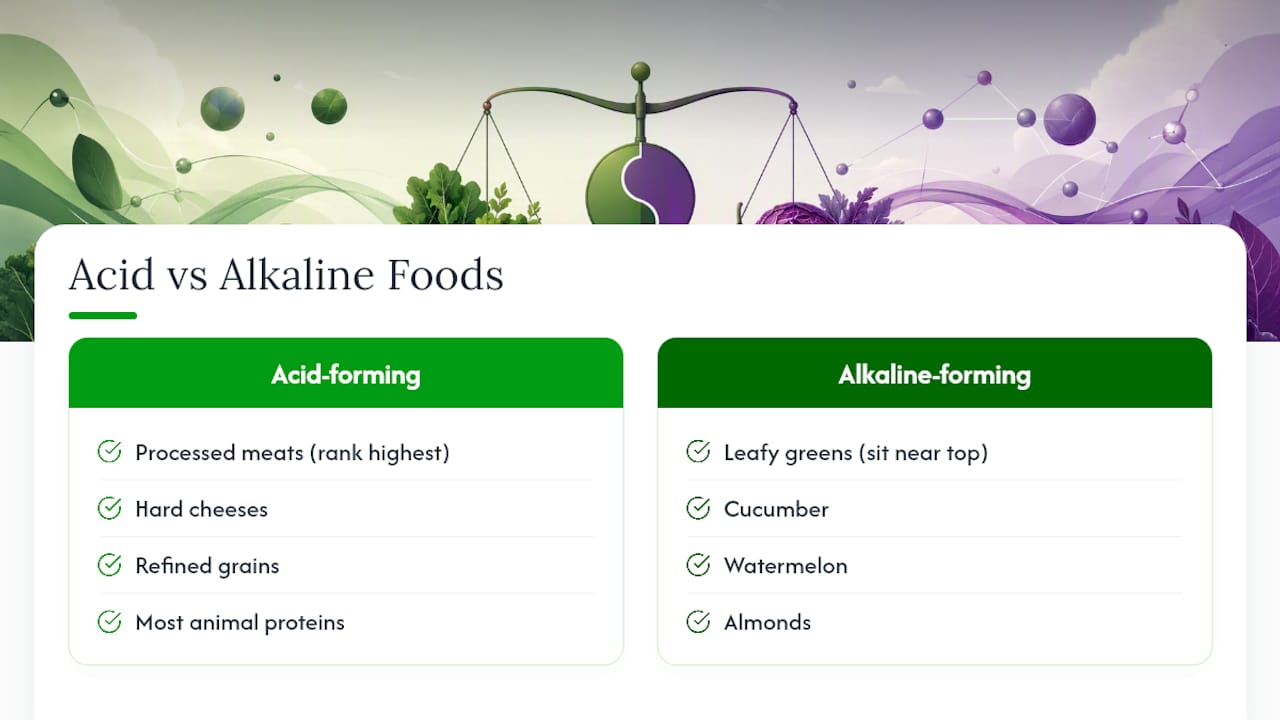
Processed meats, hard cheeses, refined grains, and most animal proteins rank highest on the acid-forming scale. Added sugar and heavily processed snacks compound the effect.
What are the most alkaline foods?
Leafy greens, cucumber, watermelon, almonds, and lentils sit near the top of the alkaline-forming list. Most fruits qualify too, even the acidic-tasting ones like lemons and oranges.
Can diet actually change my blood pH?
No, not in a healthy person. Your lungs and kidneys keep blood pH locked between 7.35 and 7.45 regardless of what you eat, as confirmed by Baylor College of Medicine. Diet changes urine pH, not blood pH.
Is an alkaline diet safe for everyone?
It’s generally safe for healthy adults when balanced. People with chronic kidney disease or those on medications affecting electrolytes should consult a clinician before making significant changes.
This article is general information, not a substitute for advice from a qualified doctor. Consult a qualified healthcare professional about your own circumstances before acting on anything here.
Sources
- The Alkaline Diet: An Evidence-Based Review
- Debating diets: what is the alkaline diet? — Baylor College of Medicine blog
- PRAL and dietary acid load research (PubMed)
- NCBI PMC review article on diet and acid–base balance