
Cellular Detoxification Explained: How Your Cells Clear Waste
Cellular detoxification is any cellular process that reduces or removes the toxicity of a substance inside cells, including transporting it away from sensitive areas or sequestering it into compartments, as defined by Gene Ontology term GO:1990748. The systems that carry this out are not a cleanse you do for a week. They run continuously, and they include:
- Autophagy — cells engulf and digest their own damaged components
- Ubiquitin–proteasome system — tags and shreds misfolded or regulatory proteins
- Lysosomal degradation — acid-filled organelles break down cellular debris
- Apoptosis and immune clearance — programmed removal of irreparably damaged cells
- Phase I–III xenobiotic metabolism — cytochrome P450 enzymes activate foreign compounds, Phase II enzymes conjugate them for water solubility, and Phase III transporters push them out of the cell
None of this resembles a juice cleanse. Commercial “detox” programs borrow the vocabulary of these real processes without engaging the biology.
Key Takeaways
Cellular detoxification is a continuous biological process running through autophagy, the ubiquitin–proteasome system, lysosomal degradation, and Phase I–III xenobiotic metabolism, best supported by sleep, exercise, whole-food nutrition, and reduced pollutant exposure.
| Point | Details |
|---|---|
| Cellular vs. commercial detox | Cellular detox is a continuous biological process; commercial “cleanses” do not activate these mechanisms on demand. |
| Core mechanisms | Autophagy, ubiquitin–proteasome, lysosomal degradation, and Phase I–III metabolism each clear different categories of cellular waste. |
| Realistic timelines | Proteasomal turnover takes minutes to hours; clearing persistent organic pollutants stored in fat takes months to years of sustained lifestyle change. |
| Top lifestyle supports | Sleep, regular exercise, hydration, fiber-rich whole foods, and reduced alcohol and pollutant exposure have the strongest evidence base. |
| Alkaherbs’ role | Alkaherbs’ alkaline herbs can complement a lifestyle foundation using a drainage-first sequence; always check interactions with a healthcare provider. |
Table of Contents
- What cellular detoxification actually covers
- How your cells actually perform detoxification
- How long does cellular detox take, and what slows it down?
- What the evidence actually supports, and where it stops
- Practical steps to support your cellular detox process
- Where cellular detox research is heading
- Alkaherbs’ herbal supports for your cellular detox foundation
- Sources
What cellular detoxification actually covers
The formal definition covers any cellular mechanism that neutralizes, transports, or compartmentalizes a toxic substance, from reactive oxygen species generated during normal metabolism to environmental pollutants absorbed from food, air, and water. That scope is much narrower than the marketing use of “detox,” and much more specific than organ-level elimination.
Organ-level elimination, handled by the liver, kidneys, skin, and gut, is real and important. But it is downstream of cellular detoxification. Before the liver can conjugate a compound for urinary excretion, individual hepatocytes must first process it through Phase I–III enzyme systems. The cell acts first; the organ acts second.
Commercial “detox” diets typically target neither level with any precision. They may support general nutrition, which indirectly helps, but they do not activate autophagy on command or meaningfully accelerate CYP enzyme activity in healthy people. That distinction matters for anyone trying to make smart decisions about their health.
How your cells actually perform detoxification
The cellular detox process runs through several parallel systems, each handling a different category of molecular garbage.
Autophagy
When a cell identifies damaged organelles, protein aggregates, or invading pathogens, it wraps them in a double-membrane structure called an autophagosome. That structure fuses with a lysosome, and the contents are broken down into reusable building blocks. Autophagosomes form within hours of a fasting or exercise stimulus, and the process clears damaged mitochondria (a subprocess called mitophagy) as well as misfolded proteins that the proteasome cannot handle alone.
Ubiquitin–proteasome system
Short-lived regulatory proteins and misfolded proteins get a different treatment. The cell tags them with chains of ubiquitin, a small protein that acts as a molecular flag. The flagged protein is then fed into the proteasome, a barrel-shaped complex that unfolds and cleaves it into peptide fragments. This pathway and lysosomal degradation together represent the two major routes for removing damaged proteins from cells. Proteasomal turnover of short-lived regulatory proteins happens in minutes to hours, which is why this system controls cell-cycle checkpoints and stress responses so precisely.
Lysosomal degradation and lysophagy
Lysosomes are the cell’s acid-filled recycling bins. They degrade material delivered by autophagosomes and also process material taken in from outside the cell. The problem is that lysosomes themselves can be damaged, especially by crystalline toxins, lipid overload, or pathogens. When that happens, cells activate a tiered response: membrane repair first, then selective autophagy of the damaged lysosome (lysophagy), and finally mTORC1-governed synthesis of new lysosomes. These lysosomal damage responses are critical for cellular homeostasis and are implicated in neurodegeneration and infection.
Apoptosis and immune clearance
Cells that are too damaged to repair trigger apoptosis, a controlled self-destruction program that prevents toxic contents from spilling into surrounding tissue. Immune cells, particularly macrophages, then clear the debris. Senescent cells that resist apoptosis are a growing research concern because they accumulate with age and release inflammatory signals that impair neighboring cells’ detox capacity.
Phase I–III xenobiotic metabolism
Foreign compounds, from medications to pesticide residues, move through a three-phase process. Phase I uses cytochrome P450 (CYP) enzymes to oxidize, reduce, or hydrolyze the compound, often making it more reactive. Phase II enzymes, including glutathione S-transferases (GSTs), UDP-glucuronosyltransferases (UGTs), sulfotransferases (SULTs), and N-acetyltransferases (NATs), attach water-soluble groups to neutralize that reactivity. Phase III membrane transporters then export the conjugated compound out of the cell for elimination by the liver or kidneys.
| Mechanism | What it clears | Key molecules/enzymes | Most active when |
|---|---|---|---|
| Autophagy | Damaged organelles, protein aggregates, pathogens | Beclin-1, LC3, ATG proteins | Fasting, exercise, sleep |
| Ubiquitin–proteasome | Misfolded and short-lived regulatory proteins | Ubiquitin, 26S proteasome, E1/E2/E3 ligases | Baseline, stress response |
| Lysosomal degradation | Bulk cellular debris, extracellular material | Cathepsins, LAMP proteins, mTORC1 | Nutrient deprivation, lysophagy |
| Apoptosis/immune clearance | Irreparably damaged or senescent cells | Caspases, macrophage phagocytosis | Chronic damage, infection |
| Phase I–III metabolism | Xenobiotics, drugs, environmental toxins | CYP enzymes, GSTs, UGTs, ABC transporters | Continuous, peaks with exposure |
Pro Tip: Genetic polymorphisms in CYP enzymes and GSTs mean two people eating identical diets can metabolize the same compound at very different rates. If you have a family history of chemical sensitivity or adverse drug reactions, that variability is worth discussing with a clinician before starting any aggressive detox protocol.
How long does cellular detox take, and what slows it down?
Different processes run on wildly different clocks. Proteasomal degradation of a short-lived regulatory protein can complete in minutes. Phase II conjugation of a xenobiotic happens within hours of exposure. Autophagic upregulation after a fasting stimulus builds over hours and peaks after roughly 24–48 hours of sustained caloric restriction in most studies.
The harder problem is persistent organic pollutants (POPs) and heavy metals stored in fat tissue and bone. These compounds have biological half-lives measured in years, not hours. Reducing the steady-state burden of POPs requires sustained lifestyle change over months to years, not a weekend cleanse.
Several factors determine where your cellular detox capacity sits on any given day:
- Age — autophagy efficiency and proteasome activity both decline with aging; senescent cells accumulate and impair neighboring tissue
- Genetics — polymorphisms in CYP2D6, CYP1A2, GSTM1, and GSTT1 can significantly alter Phase I and II metabolism rates
- Exposure load — high cumulative exposure to heavy metals, POPs, or alcohol overwhelms enzyme systems faster than they can clear
- Liver and kidney function — fatty liver disease and chronic kidney disease reduce the organ-level clearance that cellular detox feeds into
- Sleep quality — during sleep, cerebrospinal fluid flow increases and clears metabolic waste from the brain; adequate hydration and sleep support renal and neurological clearance
- Body fat percentage — higher fat mass stores more lipophilic toxins, extending effective half-lives
- Hydration — insufficient water reduces renal filtration and slows Phase III excretion
- Exercise — regular physical activity supports liver and kidney perfusion and stimulates autophagy
Pro Tip: Three conditions signal that your detox capacity may be meaningfully compromised: a diagnosis of non-alcoholic fatty liver disease (NAFLD), chronic kidney disease (CKD) at any stage, or polypharmacy (five or more concurrent medications). In any of these cases, consult a physician before adding mobilizing agents or high-dose supplements.
What the evidence actually supports, and where it stops
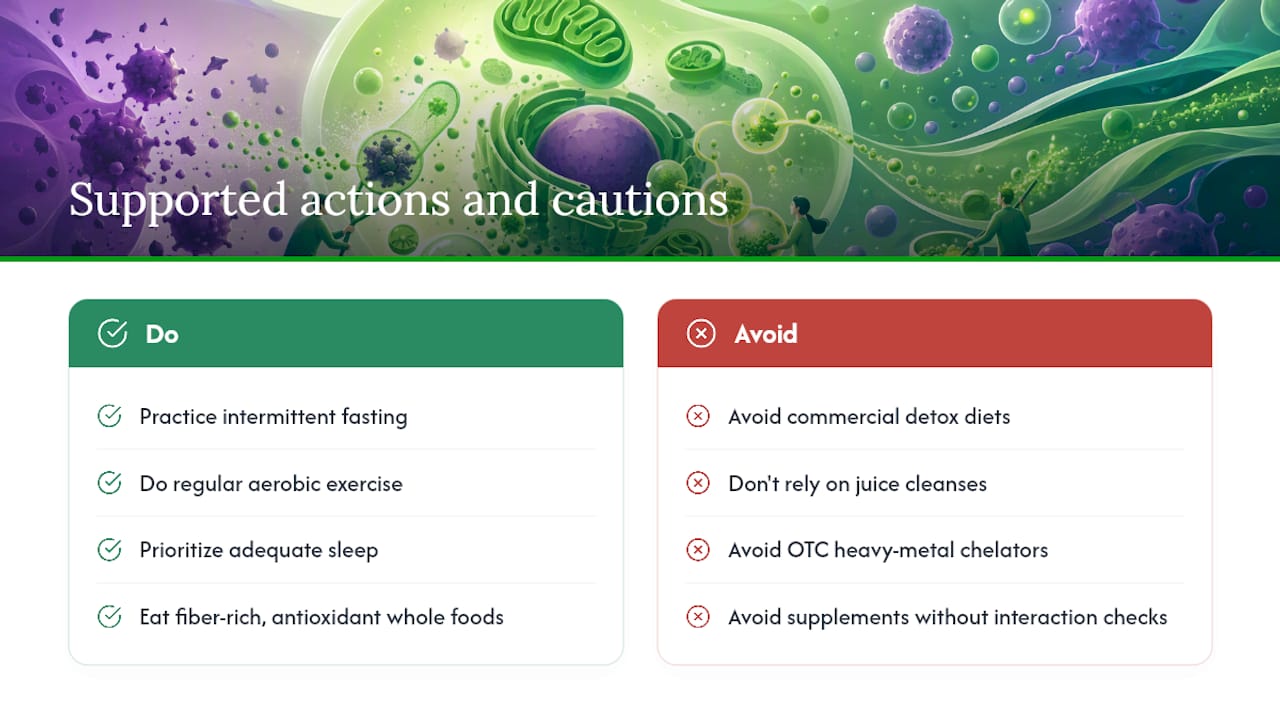
The strongest evidence for supporting cellular detoxification comes from interventions that work with existing physiology rather than trying to override it.
What research backs:
Caloric restriction and intermittent fasting reliably upregulate autophagy in animal models and show consistent signals in human studies. Regular aerobic exercise supports liver and kidney perfusion, stimulates mitophagy, and improves Phase I enzyme activity. Adequate sleep is tied to glymphatic clearance in the brain. Fiber binds bile acids and some toxins in the gut, reducing enterohepatic recirculation. Antioxidant-rich whole foods support Phase II conjugation by providing glutathione precursors and cofactors. Detoxification is best understood as an ongoing physiological process supported by multiple organs through lifestyle foundations, not a one-time purge.
Where the evidence runs thin:
Most commercial detox diets have not been tested against specific toxin loads in controlled trials. The claim that a short juice cleanse “resets” cellular detox pathways has no mechanistic basis. Juice fasting may briefly reduce caloric intake and thus lower the incoming xenobiotic load, but it does not meaningfully accelerate CYP enzyme activity or lysosomal biogenesis.
The “heavy metal detox” claim is a particular problem. Chelation therapy for documented heavy metal poisoning is a real, medically supervised intervention. Over-the-counter products claiming to chelate heavy metals have not demonstrated that effect in clinical trials, and some carry risks of their own.
Pro Tip: Before adding any supplement marketed for “detox support,” check whether it has known interactions with your current medications. St. John’s Wort, for example, is a potent CYP3A4 inducer that can reduce the effectiveness of dozens of drugs. Herb-drug interactions are real and underreported.
Practical steps to support your cellular detox process
These are ranked by evidence strength and safety margin, not by how dramatic they sound.
-
Prioritize sleep (7–9 hours consistently). Glymphatic clearance of brain metabolic waste is most active during slow-wave sleep. Chronic sleep restriction accumulates the kind of protein debris that autophagy is meant to clear.
-
Exercise regularly. Moderate aerobic exercise, 150 minutes per week as a baseline, stimulates autophagy, supports liver and kidney perfusion, and improves mitochondrial quality. Resistance training adds mitophagy benefits.
-
Stay well hydrated. Water is the medium for Phase III excretion through urine. Mild chronic dehydration measurably reduces renal clearance rates.
-
Eat a fiber-rich, whole-food diet. Fiber binds some toxins and bile acids in the gut, and antioxidant-rich foods provide glutathione precursors that fuel Phase II conjugation. Cruciferous vegetables are particularly well-studied for supporting Phase II enzyme induction.
-
Add polyphenol-rich foods. Berries, green tea, and dark leafy greens provide compounds that support Nrf2 pathway activation, which upregulates several Phase II enzymes. See also the liver detox evidence guide for a deeper look at how specific foods interact with hepatic detox pathways.
-
Reduce avoidable pollutant exposure. Filtering drinking water, choosing lower-pesticide produce when possible, and limiting alcohol all reduce the incoming load on Phase I–III systems. Less input means less demand on clearance capacity.
-
Consider intermittent fasting cautiously. A 16:8 eating window or periodic 24-hour fasts can stimulate autophagy, but this approach is contraindicated in pregnancy, active eating disorder recovery, type 1 diabetes without medical supervision, and several other conditions. Start conservatively and monitor how you feel.
-
Open drainage pathways before mobilizing. This is a principle from clinical detox practice: support bowel regularity, bile flow (through adequate fat intake and fiber), and kidney function for several weeks before adding any agent designed to mobilize stored toxins. Mobilizing toxins into circulation without adequate clearance routes risks recirculation and redistribution.
-
Use binders with timing awareness. Agents like activated charcoal or chlorella that bind toxins in the gut must be timed away from meals and medications to avoid binding nutrients and drugs along with the intended targets.
-
Seek medical supervision for serious exposures. Documented heavy metal toxicity, mold illness, or significant pharmaceutical burden requires a clinician, not a supplement protocol. This is not a limitation of natural approaches; it is a basic safety principle.
Pro Tip: Pushing cells to dump stored toxins when they are energetically compromised can cause harm rather than relief. If you are dealing with chronic fatigue, mitochondrial dysfunction, or significant illness, prioritize cellular energy support (quality sleep, nutrient density, gentle movement) before adding any mobilizing protocol.
Where cellular detox research is heading
The most active research directions in cellular detoxification are not about supplements. They are about understanding and modulating the machinery itself.
Autophagy modulation is a central focus because autophagy decline is implicated in Alzheimer’s disease, Parkinson’s disease, and several cancers. Researchers are investigating whether pharmacological autophagy inducers (beyond rapamycin, which has significant side effects) could slow neurodegeneration by clearing the protein aggregates, amyloid-beta and alpha-synuclein, that define these diseases. Intermittent fasting remains one of the few accessible interventions with a plausible mechanism here.
Senolytics are compounds designed to selectively clear senescent cells, the damaged cells that resist apoptosis and emit inflammatory signals. Early clinical trials are underway, but the field is still establishing safety and specificity. The concept is promising; the clinical translation is years away from broad recommendations.
Lysosomal repair and biogenesis is an emerging area following the recognition that lysosomal damage is a common upstream event in multiple diseases. Compounds that support lysosomal membrane integrity or accelerate mTORC1-governed biogenesis are being studied in preclinical models.
- Targeted transporter modulation (Phase III) is being explored to improve drug clearance in cancer treatment and reduce toxin accumulation in genetic transporter deficiencies
- TFEB activation (the transcription factor that governs lysosomal biogenesis) is a research target for both neurodegeneration and lysosomal storage diseases
- Mitophagy-specific inducers are being developed to address the mitochondrial dysfunction that underlies aging-related cellular detox decline
The honest summary: the foundational lifestyle interventions (sleep, exercise, whole foods, fasting) are the most accessible tools available now. The pharmacological tools are coming, but they are not ready for self-directed use.
A perspective on realistic expectations
The science of cellular detoxification is genuinely fascinating, and it also gets weaponized constantly to sell things that cannot do what they claim. What the research consistently shows is that the most powerful levers are the least glamorous ones: consistent sleep, regular movement, whole-food nutrition, and reducing exposure to avoidable toxins. These are not exciting product pitches. They are the actual biology.
Herbal supports, including the alkaline herbs Alkaherbs sources, can play a real supporting role in this picture, particularly for liver support, bile flow, and mineral replenishment during active protocols. But they work best as additions to a solid lifestyle foundation, not substitutes for one. Anyone who tells you a single herb or supplement will “detox your cells” is describing a mechanism the product has not been tested to perform.
The most useful frame is this: your cells are already running detoxification continuously. The goal is not to trigger it. The goal is to stop undermining it and give it what it needs to run well.
Alkaherbs’ herbal supports for your cellular detox foundation

If you have built the lifestyle foundations and want to add targeted herbal support, Alkaherbs offers organic, non-GMO alkaline herbs sourced with the quality standards that matter when you are putting something into a body you are trying to support, not stress.
For daily support, the alkaline herbal teas are a practical starting point: gentle, food-grade botanicals that fit into a daily routine without disrupting medications or overwhelming drainage pathways. For those further along in a structured protocol, the herbal detox collection includes single-ingredient and blended options designed around the drainage-first principle: support liver, bowels, and kidneys before adding mobilizers.
Drainage first, always. Support bile flow and bowel regularity for at least two to four weeks before adding any mobilizing or binding agent. Check interactions with any current medications with your pharmacist or physician.
Browse the full range of alkaline herbs or start with the Full Body Detox 30-Day Supply if you want a structured starting point. As with any herbal protocol, consult your healthcare provider if you are pregnant, managing a chronic condition, or taking prescription medications.
This article provides general health information and is not a substitute for professional medical advice. Confirm any protocol with a qualified healthcare provider.
Sources
- cellular detoxification (GO:1990748)
- Chapter excerpt on protein degradation and autophagy (NCBI Bookshelf)
- Lysosomal damage responses and lysophagy (Annual Review)
- Review emphasizing lifestyle supports for detoxification (PMC article)
- How to help your body detox itself (BBC Future)