

Alkaline Minerals and Detoxification: A Natural Health Guide
Alkaline minerals support your body’s detoxification systems primarily by increasing alkali reserves, raising urinary pH, and reducing the acid load your kidneys must process every day. They don’t rewrite your blood chemistry — your body guards arterial pH within a narrow range regardless of what you eat. What they do is measurable and physiologically meaningful: less renal buffering stress, lower concentrations of stone-forming compounds in urine, and better mineral status when you’re using quality, cofactor-containing sources.
The role of alkaline minerals in detoxification is best understood as support for existing waste-management systems, not a replacement for them. Alkaherbs, which draws on Dr. Sebi’s mineral-focused herbal philosophy, frames this well: replenish what the body needs, reduce the acid load it carries, and let the kidneys and liver perform their jobs more efficiently.
Quick benefits you may notice within days to weeks:
- Urinary pH shifts toward a more alkaline range, measurable with inexpensive pH strips
- Reduced acid load on the kidneys, especially when bicarbonate or citrate-rich sources are used
- Improved mineral status (magnesium, potassium, calcium) when sources include natural cofactors
Registered dietitian Anthony DiMarino notes that the real benefits of an alkaline-focused diet come from food quality and reduced processed food intake, not from any change in blood pH.
Table of Contents
- How do alkaline minerals actually support detoxification in the body?
- Which minerals count as ‘alkaline’ and where do you find them?
- What does the science actually support, and what doesn’t hold up?
- A realistic 4-week plan to support detoxification with alkaline minerals
- When can alkaline minerals be unsafe?
- Key Takeaways
- Why an evidence-informed herbal approach matters more than the hype
- Alkaherbs products that fit the 4-week mineral plan
- Useful sources and further reading
How do alkaline minerals actually support detoxification in the body?
Your kidneys handle acid-base balance through a process called net acid excretion (NAE). Every day, your metabolism produces acids from protein breakdown, cellular respiration, and other processes. The proximal tubule of the kidney reclaims bicarbonate and secretes hydrogen ions to keep serum pH stable. When your dietary acid load is high and your alkali reserves are low, the kidneys work harder, and renal tissue faces greater oxidative stress over time.

Bicarbonate, citrate, potassium, and magnesium each play a role in easing that burden. Bicarbonate-rich mineral water raises urinary pH, reduces net acid excretion, and lowers urinary concentrations of calcium and oxalate, the two main building blocks of kidney stones. Citrate is particularly useful because it binds calcium in urine, reducing crystal formation, and it also acts as an antioxidant in renal tissue.
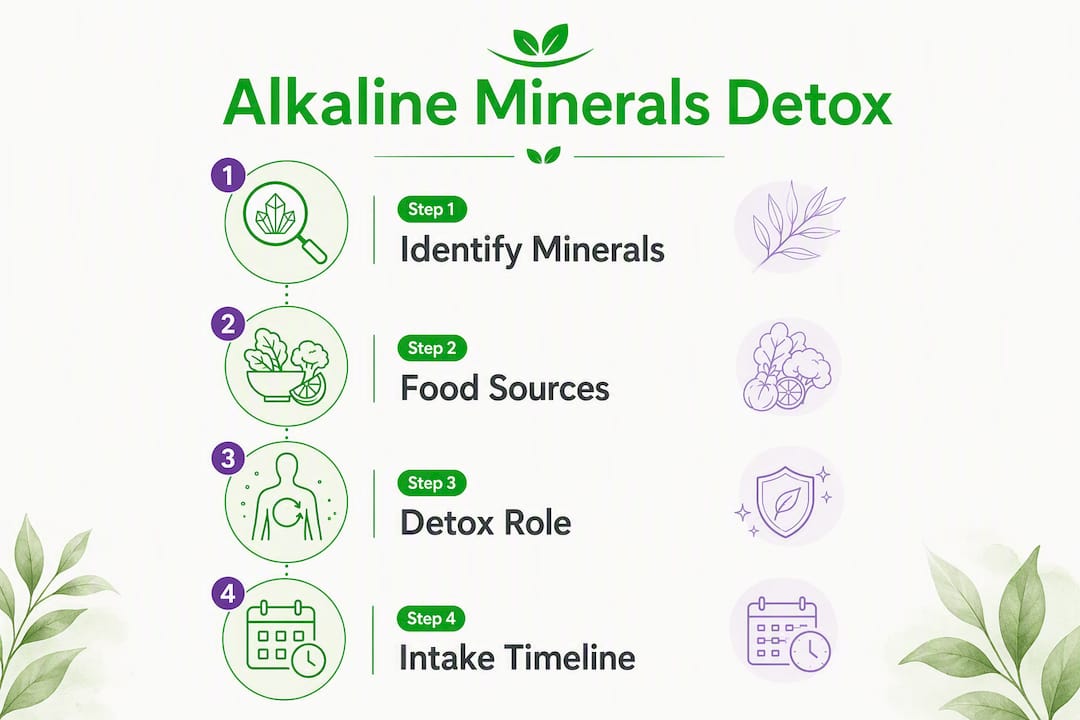
Magnesium works as a cofactor in over 300 enzymatic reactions, including those involved in energy metabolism and cellular repair. Potassium supports intracellular buffering, helping cells manage acid-base shifts without placing the entire burden on the kidneys.
Measurable markers to track:
- Morning urinary pH (mUpH): Responds faster to alkali loads than serum bicarbonate; a shift toward 6.5–7.5 is a positive signal
- Net acid excretion: Decreases with consistent bicarbonate or citrate intake
- Urinary oxalate and calcium: Surrogate markers for stone risk that improve with alkaline mineral intake
Realistic timeline: urinary pH changes can appear within days of consistent intake. Reductions in stone-risk markers typically take two to four weeks of sustained dietary change.
Which minerals count as ‘alkaline’ and where do you find them?
The term “alkaline minerals” refers to minerals and mineral compounds that reduce dietary acid load or directly contribute to the body’s buffering capacity. The main players are bicarbonate, citrate, potassium, calcium, magnesium, and sulfur-containing compounds.
| Mineral/Compound | Primary Role | Key Food Sources |
|---|---|---|
| Bicarbonate | Direct buffering; raises urinary pH | Mineral waters (>1,300 mg/L), baking soda (use cautiously) |
| Citrate | Binds urinary calcium; antioxidant in renal tissue | Lemons, limes, oranges, citrus fruits |
| Potassium | Intracellular buffering; reduces acid load | Leafy greens, bananas, avocado, sea moss |
| Magnesium | Enzymatic cofactor; reduces stone risk | Pumpkin seeds, dark leafy greens, seaweeds |
| Calcium | Bone mineral balance; binds oxalate in gut | Kale, bok choy, fortified plant milks, sea moss |
| Sulfur compounds | Glutathione precursors; support detox pathways | Cruciferous vegetables, garlic, onions |
Sebian Sea Moss, one of Alkaherbs’ flagship products, is a standout source because it provides potassium, magnesium, and calcium together with trace minerals in a naturally occurring matrix. That combination matters. Alkaline waters or supplements that lack cofactors like magnesium and citrate often fail to reproduce the physiological benefits seen in clinical trials using naturally mineral-rich sources.
Whole-food sources worth prioritizing:
- Leafy greens (spinach, kale, dandelion greens) for potassium and magnesium
- Citrus fruits for citrate and vitamin C
- Seaweeds (sea moss, dulse, bladderwrack) for a broad mineral spectrum
- Cruciferous vegetables (broccoli, cabbage) for sulfur amino acids that feed glutathione synthesis
- Bicarbonate-rich mineral waters as a hydration upgrade
Pro Tip: When choosing a mineral water, check the label for bicarbonate content. Waters listing bicarbonate in the higher ranges are the ones most studied for urinary pH effects. Pair them with citrus-rich meals for a natural citrate boost.
What does the science actually support, and what doesn’t hold up?
The evidence for alkaline minerals is real but specific. Bicarbonate-rich mineral water reduces net acid excretion and lowers stone-forming urinary constituents, and a mouse-model study found that high-pH alkaline mineral water reduced calcium oxalate crystal formation, renal fibrosis, and oxidative stress markers compared with controls. In a randomized cohort trial, citrate compounds reduced intrarenal oxidative stress in mild-stage CKD patients when dosing was guided by urinary pH. Sodium bicarbonate, by contrast, showed mixed results in the same trial, partly because the sodium load can offset renal benefits.
What the science does not support is the popular claim that an alkaline diet changes your blood pH.
| Claim | Reality |
|---|---|
| “Alkaline diet raises blood pH” | Blood pH is tightly regulated; diet doesn’t meaningfully shift it |
| “All alkaline supplements work the same” | Citrate and bicarbonate have different renal effects; sodium load matters |
| “Alkaline water detoxes the liver” | No direct evidence; liver detox depends on nutrient status, not water pH |
| “Urinary pH change = blood pH change” | Urinary pH reflects kidney excretion, not systemic acid-base status |
Research gaps are real: most trials are small, short-term, or conducted in CKD populations. Long-term outcomes in healthy adults remain understudied.
A realistic 4-week plan to support detoxification with alkaline minerals
Start with food and hydration before adding any supplement. That’s the order that matches the evidence and minimizes risk.
Week-by-week progression:
- Week 1 — Baseline shift: Replace processed foods with leafy greens, cruciferous vegetables, and citrus daily. Switch to a bicarbonate-rich mineral water as your primary hydration source. Begin tracking morning urinary pH with pH strips.
- Week 2 — Add mineral-rich foods: Incorporate seaweeds (Sebian Sea Moss gel or capsules work well here), avocado, pumpkin seeds, and additional citrus. Aim for two to three servings of alkaline-forming foods at each meal. Check the alkaline diet starter herb list for Dr. Sebi–inspired additions.
- Week 3 — Gentle herbal support: Consider adding Duck Flower or an Alkaherbs herbal detox blend as a supervised addition. These are best introduced after the dietary foundation is in place, not as a shortcut around it. If you’re on any medications, consult a clinician before this step.
- Week 4 — Monitor and maintain: Review your urinary pH log. Adjust mineral water intake or food choices based on trends. Focus shifts from loading to consistency.
What to track:
- Morning urinary pH (target range: 6.5–7.5)
- Digestion quality and regularity
- Energy levels across the day
- Hydration (urine color as a secondary check)
- Any signs of electrolyte imbalance (muscle cramps, fatigue, palpitations)
Pro Tip: Track mUpH before eating or drinking anything. That first-morning reading gives you the clearest signal of how your body is handling overnight acid excretion, without food variables muddying the result.
For a broader framework on holistic detox workflows, especially if you’re over 45, a structured approach that layers dietary change before supplementation tends to produce more consistent outcomes.
When can alkaline minerals be unsafe?
Alkaline mineral supplementation is not appropriate for everyone, and a few groups face real risks.
Highest-risk groups:
- Advanced chronic kidney disease (CKD stages 3b–5): Impaired kidneys can’t regulate potassium or bicarbonate excretion normally; supplementation can cause dangerous electrolyte shifts
- Uncontrolled hypertension: Sodium-based alkalinizers (sodium bicarbonate) raise sodium load and can worsen blood pressure
- Potassium-sparing diuretics or ACE inhibitors/ARBs: Adding potassium-rich supplements risks hyperkalemia
- Proton pump inhibitor (PPI) users: PPIs reduce stomach acid and alter magnesium absorption; adding alkalinizing agents can compound mineral imbalances
Before supplementing, consider these baseline checks:
- eGFR and serum creatinine (kidney function)
- Serum electrolytes (potassium, sodium, bicarbonate)
- Medication review with a pharmacist or physician
Stop and seek care if you notice:
- Muscle weakness or cramps
- Heart palpitations
- Unusual swelling
- Blood pressure changes outside your normal range
Pro Tip: If you’re supplementing with any alkalinizing agent regularly, a basic metabolic panel every three to six months gives you early warning of electrolyte drift before symptoms appear.
Alkalinizing supplementation should complement, not replace, medical care when a clinical condition is present.
This article provides general health information, not medical advice. Confirm any supplement or dietary change with a qualified clinician, especially if you have kidney disease, cardiovascular conditions, or take prescription medications.
Key Takeaways
Alkaline minerals support detoxification by reducing renal acid load and raising urinary pH, not by altering blood pH, which the body regulates independently of diet.
| Point | Details |
|---|---|
| Mechanism is renal, not systemic | Alkaline minerals reduce net acid excretion and urinary stone-forming compounds, not blood pH |
| Cofactors determine effectiveness | Sources with magnesium and citrate (sea moss, citrus, mineral water) outperform isolated synthetic alkalinizers |
| Citrate shows strongest clinical signal | Citrate compounds reduced intrarenal oxidative stress in mild CKD trials when dosed by urinary pH |
| Safety depends on kidney function | Advanced CKD, potassium-sparing medications, and sodium-sensitive conditions require clinical oversight |
| Alkaherbs products fit Weeks 2–3 | Sebian Sea Moss and Duck Flower align with the mineral-loading and herbal support phases of the 4-week plan |
Why an evidence-informed herbal approach matters more than the hype
The wellness space is full of detox claims that outrun the evidence by miles. What strikes me about the physiology here is how modest and specific the real benefits are — and how that modesty actually makes them more trustworthy. Urinary pH shifts. Reduced oxalate concentration. Lower renal oxidative stress in people with early kidney disease. These aren’t dramatic transformations; they’re measurable, reproducible signals that something physiologically useful is happening.
The Dr. Sebi–inspired approach that Alkaherbs is built on has always emphasized mineral replenishment from whole, plant-derived sources rather than isolated compounds. This aligns well with what the clinical evidence actually shows: cofactor-rich, naturally occurring mineral matrices perform better than synthetic alkalinizers in most settings. Organic, non-GMO sourcing and third-party testing aren’t just marketing language here; they are the difference between a product that delivers its mineral matrix intact and one that doesn’t.
The 4-week plan in this article isn’t a detox protocol in the dramatic sense. It’s a structured way to reduce your dietary acid load, replenish minerals your body uses for buffering, and monitor whether it’s working. That’s a reasonable, evidence-grounded thing to do.
Alkaherbs products that fit the 4-week mineral plan
Alkaherbs stocks mineral-rich herbs and blends that map directly to the dietary and herbal phases of the plan described above, all sourced organically and non-GMO with third-party quality testing.

Sebian Sea Moss is the mineral-replenishment anchor for Week 2. It provides potassium, magnesium, calcium, and trace minerals in a naturally occurring matrix, exactly the cofactor combination that makes mineral supplementation physiologically effective. Use it as a gel added to smoothies or as capsules if you prefer a measured dose.
Duck Flower fits Week 3 as a gentle herbal detox support. Introduce it after your dietary foundation is established, and follow the dosage guidance on the product page.
Full Body Detox (30-Day Supply) is designed for the full arc of the plan, supporting kidney and digestive pathways across a structured month. If you’re on medications or managing a kidney condition, consult your clinician before starting.
Browse the full range of alkaline herbs and herbal detox options at Alkaherbs to find the right fit for where you are in your plan.
Useful sources and further reading
- Adjustment of tissue alkalinity: bicarbonate-rich mineral water and acid-base balance — MDPI review documenting urinary pH changes, net acid excretion reductions, and stone-risk markers with bicarbonate-rich waters
- Oral alkalinizing supplementation and intrarenal oxidative stress in mild-stage CKD — Springer randomized cohort trial comparing citrate and sodium bicarbonate effects on renal oxidative stress
- Protective effect of alkaline mineral water on calcium oxalate kidney injury in mice — Wiley preclinical study showing reduced crystal formation and fibrosis with high-pH mineral water
- Alkaline diet explainer, Cleveland Clinic (Anthony DiMarino, RD) — Registered dietitian perspective on blood pH myths and realistic dietary benefits
- Minerals: Diet and Health, NCBI Bookshelf — Reference chapter on macromineral roles, absorption, and physiological functions
- Dietary macrominerals: Updated review — PMC review covering sulfur amino acids, glutathione synthesis, and mineral cofactor roles in metabolic detoxification
Consult a qualified clinician for personalized guidance, particularly if you have kidney disease or take prescription medications.