

Acidic vs Alkaline Body Effects: What Really Happens
No, food does not turn your blood acidic or alkaline. In a healthy person, blood pH stays maintained within a narrow, slightly alkaline range, no matter what you had for lunch. Your lungs and kidneys handle that job around the clock, correcting drift in minutes to hours, long before diet ever gets a vote. What food does change is your urine pH and the overall nutrient load you’re feeding your body, which is a real lever for health even though it has nothing to do with rebalancing blood chemistry.
- Blood pH range: 7.35 to 7.45, average 7.40
- Who regulates it: lungs (fast) and kidneys (slower, more precise)
- What diet actually shifts: urine pH and nutrient intake, not blood pH
The current evidence consensus is blunt about it: diet cannot change blood pH in healthy individuals. That single fact undercuts most of the alkaline diet marketing you’ve probably seen, and it’s the foundation for everything else in this guide.
Key Takeaways
Blood pH stays fixed within a narrow, healthy range in people regardless of diet, while food quality, not blood alkalinity, drives most of the real health benefits people credit to alkaline eating.
| Point | Details |
|---|---|
| Blood pH is non-negotiable | Lungs and kidneys hold it at 7.35–7.45 regardless of what you eat. |
| Diet shifts urine, not blood | Food changes urine pH within days but never touches systemic blood chemistry. |
| Real benefits come from food quality | Antioxidants and lower processed food intake, not alkalinization, drive inflammation and heart benefits. |
| True imbalances signal disease | Acidemia and alkalemia stem from kidney, metabolic, or respiratory conditions and need medical testing. |
| Alkaherbs supports the diet, not the myth | Alkaline herbal teas and sea moss complement plant-forward eating without claiming to change blood pH. |
This article is general information, not a substitute for advice from a qualified doctor. Consult a qualified healthcare professional about your own circumstances before acting on anything here.
Table of Contents
- How the Body Keeps Blood pH in Such a Narrow Range
- Can Food Change Urine pH but Not Blood pH?
- Do Alkaline Diet Claims Hold Up to Evidence?
- When Is Acid-Base Imbalance an Actual Medical Problem?
- What Should You Actually Do About Your Diet?
- Sources
How the Body Keeps Blood pH in Such a Narrow Range
Your body treats pH control like a non-negotiable survival function, because it is one. Fall below 7.35 and you’re in acidemia; climb above 7.45 and you’re in alkalemia, both of which are clinical emergencies, not dietary states. That narrow window exists because enzymes, proteins, and cell membranes only function correctly within it. A swing of even a few tenths can disrupt everything from nerve signaling to how oxygen binds to hemoglobin.
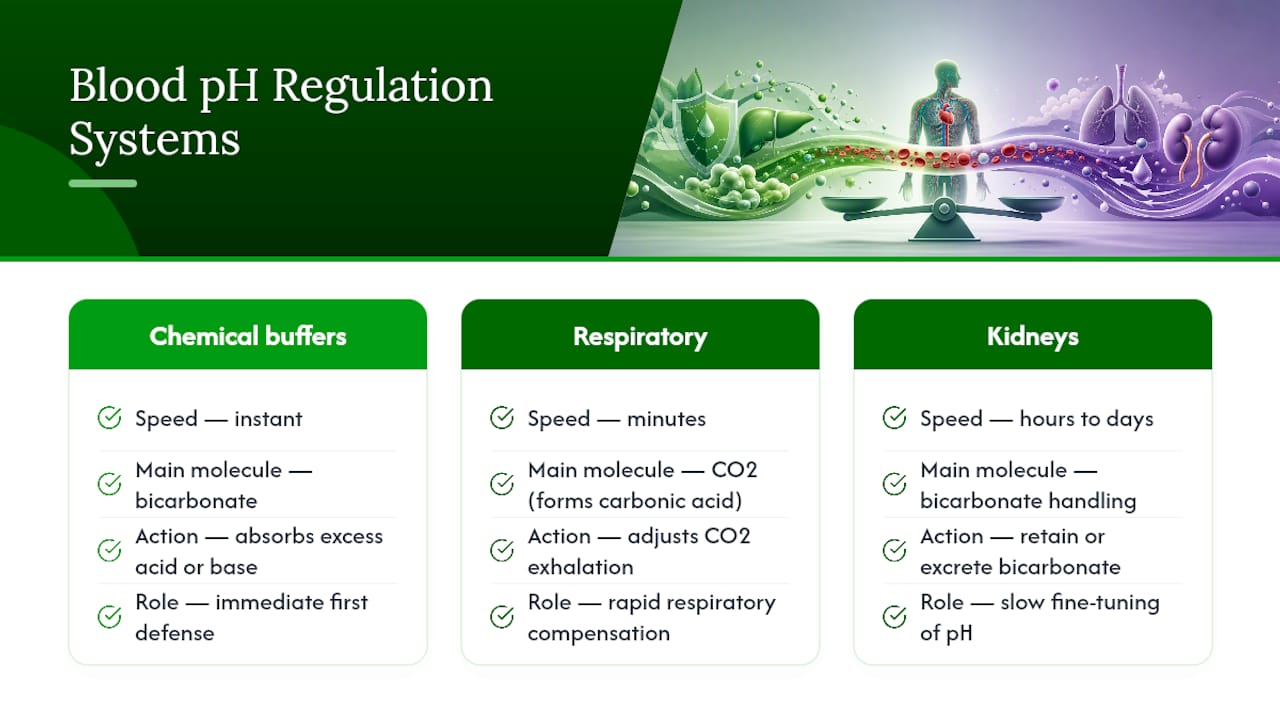
Three systems keep that window locked shut. Chemical buffers, mainly bicarbonate, act instantly, absorbing excess acid or base the second it appears. The respiratory system follows within minutes, adjusting how much carbon dioxide you exhale, since CO2 becomes carbonic acid in the blood. The kidneys work slower, over hours to days, fine tuning how much bicarbonate they retain or excrete. This layered response is why the NCBI’s clinical overview of acid-base physiology notes that respiratory compensation alone can correct a pH shift before your kidneys even finish processing yesterday’s dinner.
Doctors measure this system directly, not by guessing. An arterial blood gas (ABG) test reads pH, Pco2, and bicarbonate simultaneously, giving a precise snapshot of both the problem and which system is compensating.
Small deviations in these numbers mean a lot clinically, because the body almost never lets pH itself drift far before triggering compensation elsewhere.
Can Food Change Urine pH but Not Blood pH?
Yes, and this is where most alkaline diet confusion starts. Foods you eat, particularly high-protein meals versus fruits and vegetables, genuinely shift urine pH within a day or two, because your kidneys excrete the acid or base byproducts of digestion. That’s a real, measurable, and fast effect. It just isn’t the same thing as changing the pH of your blood, which stays chemically pinned in place regardless of what your urine looks like.

Urine pH is a readout of what your kidneys are filtering out, not a mirror of your systemic chemistry. Testing it can be informative for specific medical purposes, like monitoring kidney stone risk, but it tells you nothing about whether your blood is “too acidic.”
Here’s how common alkaline-diet gimmicks hold up against that reality:
- Alkaline water: May slightly raise stomach or urine pH temporarily; does not measurably affect blood pH, and Harvard Health considers it unnecessary for healthy people.
- pH test strips: Useful for tracking urine trends over time, but a single reading is easily skewed by hydration, time of day, and your last meal.
- Alkalizing supplements: No credible evidence they change blood pH in people with normally functioning lungs and kidneys.
Pro Tip: If you want to track urine pH, test first thing in the morning before eating or drinking, and look at the trend over a week rather than reacting to any single number. One reading tells you almost nothing; a pattern tells you how your kidneys are responding to your current diet.
For a deeper walkthrough of home testing methods and their limits, see our guide to testing body pH.
Do Alkaline Diet Claims Hold Up to Evidence?
Some of them do, just not for the reason the marketing gives you. Alkaline diet advocates often claim benefits around detoxification, immunity, reduced inflammation, and even cancer prevention. When researchers look closely, the benefit tends to be real, but the mechanism is nutrient quality, not pH change.
- Reduced inflammation: Plant-forward diets are rich in antioxidants and phytochemicals, which lower inflammatory markers. This is a food-composition effect, not blood alkalization, according to MD Anderson’s review of alkaline diet claims.
- Better heart and metabolic markers: Diets built around whole foods and away from processed meat and added sugar consistently improve these numbers, a pattern MedicalNewsToday’s clinical review attributes to the food swap itself.
- Cancer risk claims: No controlled evidence shows alkalizing the body prevents or treats cancer; MD Anderson recommends focusing on antioxidant-rich, anti-inflammatory eating instead of chasing a pH target.
The pattern across these reviews is consistent: cut processed food, add plants, and you get real outcomes, none of which required moving your blood pH anywhere. If you want examples of foods that fit that pattern, our anti-inflammatory alkaline foods list is a practical starting point.
When Is Acid-Base Imbalance an Actual Medical Problem?
Acidemia and alkalemia are real diagnoses, but they’re caused by disease and organ dysfunction, not diet. Acidemia (blood pH below 7.35) commonly stems from kidney disease, diabetic ketoacidosis, or respiratory failure that lets CO2 build up. Alkalemia (above 7.45) is often triggered by prolonged vomiting, certain diuretics, or hyperventilation from severe anxiety or lung disease.
These are classified as either metabolic or respiratory disorders, and the body attempts compensation for both. Merck Manual’s clinical reference notes that severe, uncompensated cases can affect multiple organ systems at once, which is why they’re treated as emergencies.
Warning signs worth taking seriously include:
- Confusion or sudden severe fatigue
- Rapid or labored breathing
- Muscle spasms or unexplained weakness
- Seizures in severe cases
Doctors confirm these disorders with an arterial blood gas test, serum bicarbonate, and Pco2 readings, the same measurements described earlier. If you or someone near you shows sudden confusion, seizures, or severe breathing trouble, that’s an emergency room visit, not a wait-and-see situation. Milder, persistent symptoms are worth raising with your primary care doctor.
What Should You Actually Do About Your Diet?
Skip the pH-fixing gimmicks and focus on food quality, since that’s where the real evidence points. A plant-forward pattern with less processed meat and added sugar supports measurable health markers, even though it won’t touch your blood chemistry.
- Favor vegetables, fruits, legumes, and whole grains as the base of most meals.
- Cut back on processed meats, refined sugar, and heavily packaged foods.
- Skip alkaline water and pH-correcting supplements. Your kidneys already handle this without help, per Harvard Health.
- Use urine pH testing only as a rough trend indicator, never as a diagnosis tool.
- Watch for nutrient gaps if you’re strict about avoiding “acidic” foods. The Cleveland Clinic notes that some acid-labeled foods, like lean meats and legumes, provide iron and protein your body still needs.
Pro Tip: If you shift toward a more plant-forward, alkaline-style diet, pay deliberate attention to protein, iron, and B12, especially if you’re cutting animal products significantly. A balanced plate beats a rigid rulebook every time.
For common pitfalls people run into when overhauling their diet too fast, our piece on common detox mistakes is worth a read before you start.
Balancing the Evidence With a Plant-Forward Approach
The science here is settled enough that I won’t pretend otherwise: your diet isn’t going to move your blood pH, and any product claiming to “alkalize” your blood is overselling what biology allows. What the science does support is that eating more whole plants, and fewer processed ones, genuinely improves health markers worth caring about. At Alkaherbs, that’s the honest frame we build around, using alkaline herbs as a complement to good eating, not a replacement for how your lungs and kidneys already do this job.
A Few Herbs Worth Adding to a Plant-Forward Plate
If you’re already leaning into more whole, plant-based meals, certain herbs and sea vegetables make it easier to hit your mineral targets without much extra effort.

Alkaherbs carries alkaline herbal teas as a simple daily addition, along with mineral-dense options like Purple Sea Moss for readers looking to round out a plant-forward diet with trace minerals that are easy to miss when cutting back on processed foods. None of this changes your blood pH, and we’re not going to pretend otherwise. What it can do is support the kind of nutrient-dense eating pattern the evidence actually backs. If you have a diagnosed kidney, respiratory, or metabolic condition, talk to your doctor before making major dietary changes. Ready to see what fits your routine? Browse the full alkaline herbs collection and start with one small swap.
Sources
- Acid-Base Balance and Disorders (NCBI Bookshelf)
- The alkaline diet myth (Healthline)
- The alkaline diet: what you need to know (MedicalNewsToday)
- Acid-base disorders (Merck Manual Professional Edition)
- Do I need to rebalance my pH? (Harvard Health)
- The alkaline diet: What cancer patients should know (MD Anderson)