

What Is a Herb Quality Grading System, Really?
A herb quality grading system is a set of standards that ranks alkaline and detox herbs by how they were sourced, whether their botanical identity checks out, how potent they are, whether they’re free of contaminants, and whether an independent lab has verified all of it. For anyone buying herbs for detox or blood cleansing, the practical version is simple: look for a batch-specific Certificate of Analysis (CoA), a third-party seal (USP, NSF International, or ConsumerLab), and a manufacturer that follows cGMP production standards. A retailer like Alkaherbs that publishes traceable sourcing and testing data is showing you the grade, not just claiming one.
- Prefer products with a batch-specific CoA you can actually request or view.
- Look for third-party verification, not just an in-house “lab tested” sticker.
- Check that the seller names the lab, the test date, and the methods used.
Pro Tip: Before you buy, search the product page for the words “Certificate of Analysis.” If you can’t find one in under a minute, email the seller and ask for it directly.
Key Takeaways
A trustworthy herb quality grade always rests on verifiable sourcing, botanical identity, potency testing, and contaminant screening, backed by a batch-specific CoA.
| Point | Details |
|---|---|
| Definition matters | A herb grading system ranks products by sourcing, identity, potency, contaminants, and lab verification. |
| Seals aren’t proof alone | USP, NSF, and ConsumerLab verify identity and potency, but always ask for the batch CoA too. |
| CoAs need four things | A trustworthy CoA names the lab, states the test date, and reports assay and contaminant results. |
| Red flags stop a purchase | Vague “lab tested” claims, missing batch numbers, and hidden proprietary doses invalidate any grade. |
| Alkaherbs models the standard | Alkaherbs sources alkaline herbs with traceability and cGMP-aligned practices for detox-focused buyers. |
Table of Contents
- What Are the Main Herb Grading Criteria Consumers Should Know?
- What Do USP, NSF, and ConsumerLab Actually Verify?
- How Do You Read a Herb Label and Certificate of Analysis?
- How Can You Check Herb Quality Before You Buy?
- What Questions Should You Ask a Seller, and What Are Red Flags?
- What Rules Govern Herb Supplements, and What Should You Watch For?
- How Should You Read Grade Badges and Star Ratings on Herb Products?
- How Does Alkaherbs Apply This Grading Approach?
- Where to Find Herbs That Meet These Grading Standards
- Where Can You Learn More About Herb Testing and Regulation?
- Frequently Asked Questions
- Sources
What Are the Main Herb Grading Criteria Consumers Should Know?
Retail herb grading rests on six criteria, and each one answers a different question about what you’re actually putting in your body.
Sourcing comes first: was the herb organically farmed or wildcrafted, and can the seller trace it back to a farm or region? Botanical identity comes next, confirmed through the Latin name on the label and, in more rigorous testing, DNA barcoding that proves the plant in the jar matches the plant on the label. Identity fraud is more common in the herb trade than most shoppers realize. Potency, meaning the concentration of the plant’s active marker compounds, determines whether a tincture or extract will actually do what it claims. Contaminant screening checks for heavy metals, pesticide residues, and microbial load. This one matters more for detox herbs than almost any other category, because some botanicals concentrate heavy metals from soil, and a “cleansing” herb loaded with lead defeats its own purpose.
Manufacturing controls fall under cGMP, the FDA’s current good manufacturing practice framework. It’s worth understanding what this actually guarantees: cGMP compliance is non-binding for premarket approval, meaning a company can follow cGMP guidelines without ever submitting a product for FDA review. That’s why independent testing fills the gap cGMP leaves open.
Finally, alkalinity suitability matters specifically for buyers following Dr. Sebi–style protocols, where the herb needs to fit within an alkaline dietary framework rather than just be “healthy” in a generic sense.
These criteria carry different weight depending on the product form. A dried tea leans harder on identity and contaminant testing since there’s no concentration step. A tincture or standardized extract needs disclosed extraction methods and marker-compound percentages, because standardized extracts make effects more predictable. Written specifications should cover identity, physical and chemical characteristics, and contaminant limits across the entire growing and processing chain, not just the finished product.
- Sourcing: organic certification or documented wildcrafting location.
- Identity: Latin name plus, ideally, DNA barcoding confirmation.
- Potency: marker compound assay results, often via HPLC.
- Contaminants: heavy metals, pesticides, microbial counts.
- Manufacturing: cGMP-compliant facility with disclosed processes.
- Alkalinity fit: relevance to an alkaline dietary protocol.
What Do USP, NSF, and ConsumerLab Actually Verify?
Third-party seals exist because a company grading its own product is grading its own homework. USP, NSF International, and ConsumerLab each run independent tests that check identity, potency, and contaminant levels using methods like HPLC, LC–MS, and DNA barcoding, and a seal from any of them carries far more weight than a vague “lab tested” claim printed on packaging with no name attached.
But a seal has real limits. GMP certification verifies that a facility follows consistent manufacturing processes. It does not confirm the exact potency of the specific batch sitting on a shelf. Third-party seals such as USP, NSF, and ConsumerLab remain the strongest consumer signals precisely because facility certification alone leaves a gap between “clean process” and “accurate dose.”
When you see a seal, take one more step:
- Search the brand’s site for a batch-specific CoA tied to the lot number on your bottle.
- Confirm which tests were actually run: identity, potency, heavy metals, microbes, or all four.
- Treat “GMP certified” alone as a starting point, not a finish line.
How Do You Read a Herb Label and Certificate of Analysis?
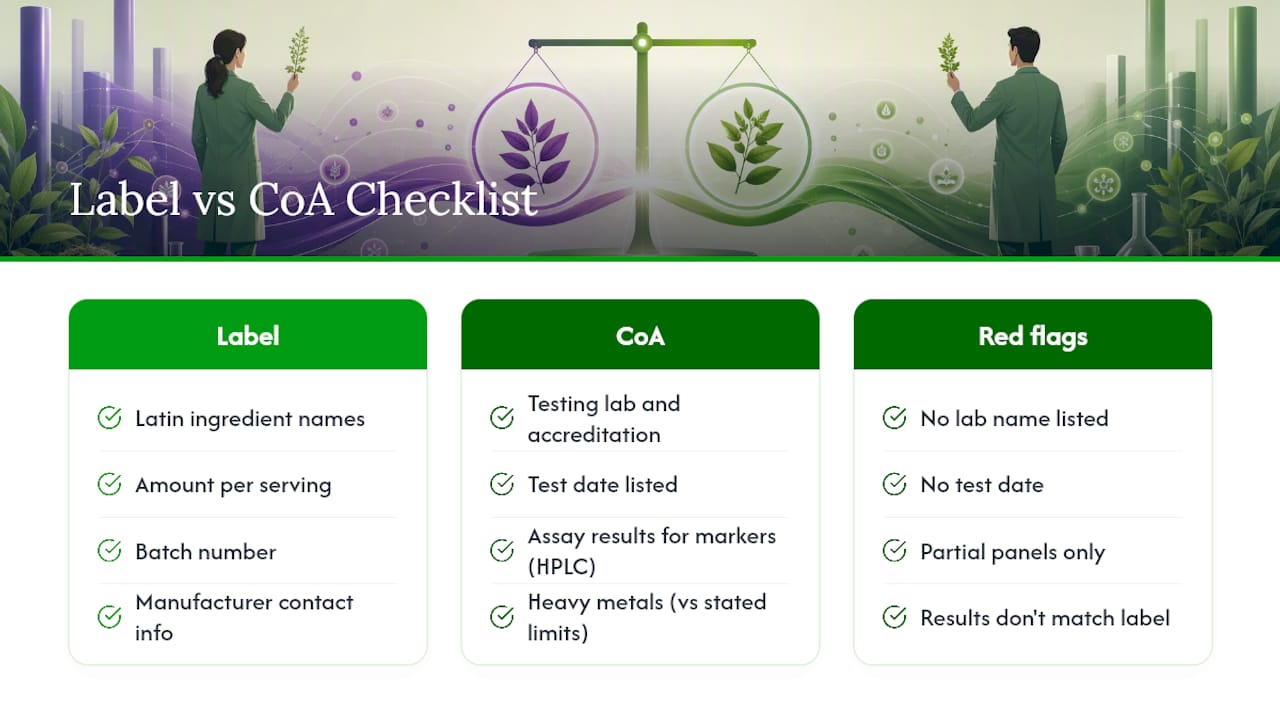
The label itself should list every ingredient by its Latin name, the amount per serving, a batch number, the manufacturer’s contact information, and the standard FDA disclaimer stating the product isn’t intended to diagnose or treat disease. If any of these are missing, that’s already a signal to look elsewhere.
The CoA is where the real evidence lives. A usable one names the testing lab and its accreditation, states the test date, and reports assay results for marker compounds, often via HPLC. It also lists heavy metal levels, pesticide residue results, and microbial counts, each measured against a stated acceptable limit. Quality botanical indicators include batch consistency, ash content for purity, and identity confirmation through HPTLC or DNA barcoding.
Watch for CoAs that fall short of this standard: no lab name listed anywhere, no test date, only partial panels (heavy metals but no microbial testing, for instance), or results that don’t line up with what the label actually claims. A CoA that only tests for one contaminant category while the label implies full-spectrum safety testing is misleading by omission, even if nothing on it is technically false.
How Can You Check Herb Quality Before You Buy?
You don’t need a lab to catch obvious problems. Check that packaging is sealed and shows no moisture damage or clumping, since either one suggests improper storage that can degrade potency or invite mold. Confirm the Latin name is printed on the label, not just a common name. Look for a batch number or QR code that links to a CoA online, and if you find one, actually open it before you buy rather than assuming it exists.
- Inspect the seal and look for moisture, clumping, or an off smell.
- Scan any QR code on the packaging to pull up batch records instantly.
- Cross-check the Latin name against what you expected to buy.
Pro Tip: If a QR code doesn’t work or a website has no CoA page, contact customer service directly and ask for the batch number’s specific test results. A brand with nothing to hide will send them.
What Questions Should You Ask a Seller, and What Are Red Flags?
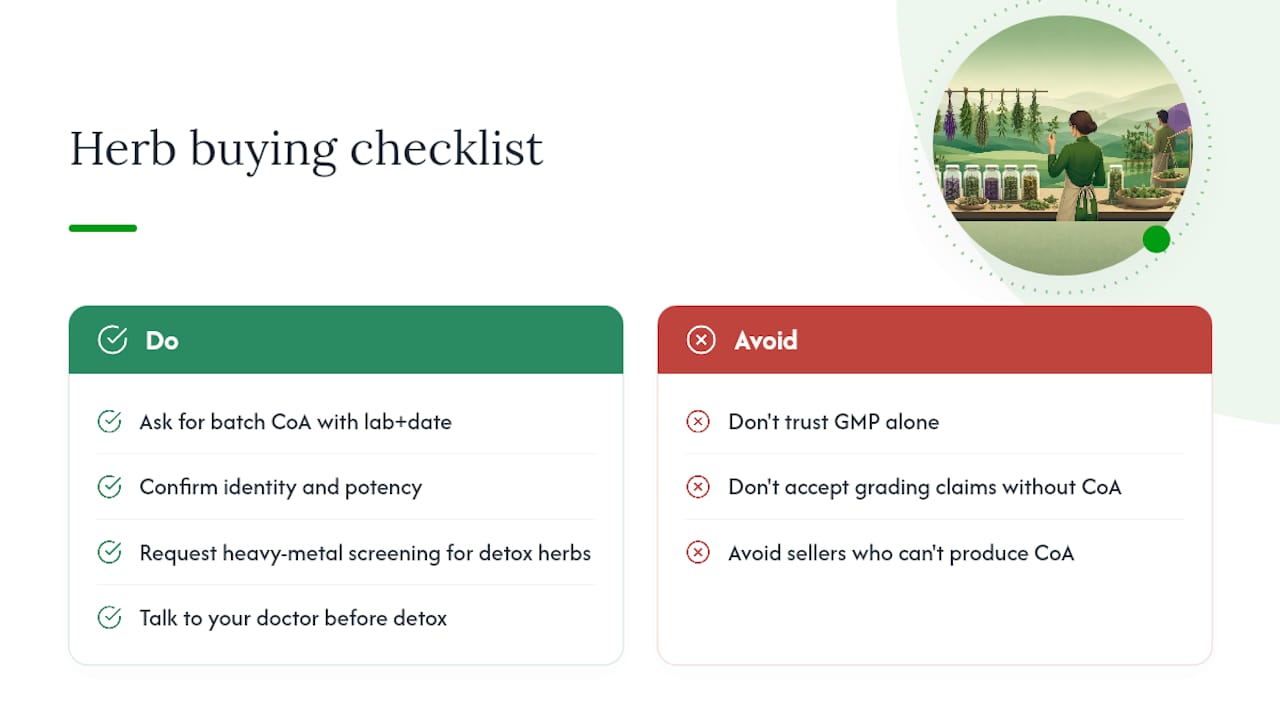
Before you commit to a purchase, ask the seller directly: Can you share a batch-specific CoA? Which lab performed it, and when? What marker compound assays were run, and what were the results? Where were the herbs grown or harvested? If it’s an extract, is it standardized, and to what percentage?
A few answers, or non-answers, should stop you cold:
- Vague “lab tested” language with no lab name attached anywhere.
- No batch numbers on the product or in seller communication.
- Undisclosed extraction methods for tinctures and concentrated extracts.
- Missing Latin names on any listed botanical ingredient.
- Proprietary blends that hide individual ingredient doses.
- Health claims that sound too sweeping to be backed by evidence.
Regulators have already flagged herbal detox products for false claims and unlisted or harmful ingredient levels, which is exactly why a badge or seal on packaging doesn’t override a missing CoA. A pretty logo means nothing if the paperwork behind it doesn’t exist.
What Rules Govern Herb Supplements, and What Should You Watch For?
Herbs sold as dietary supplements in the United States fall under a framework that requires accurate labeling but does not require premarket approval the way drugs do. cGMP guidelines exist to ensure identity, purity, strength, and composition, but adoption is uneven across manufacturers, which is exactly why third-party testing matters so much for anyone buying herbs to support a detox routine.
“Natural” is not a safety guarantee. Some of the highest-potency detox herbs are potent precisely because they contain active compounds that can interact with medications or existing health conditions.
The term “natural” does not mean “safe.” Consumers should look for clear, evidence-based ingredient information and talk to a healthcare provider before starting any detox protocol.
Talk to a doctor before starting a new detox regimen, especially if you take prescription medication or manage a chronic condition.
- DSHEA governs labeling, not premarket testing, for most herbal supplements.
- cGMP sets manufacturing standards but doesn’t certify individual batch potency.
- “Natural” and “safe” are not interchangeable claims.
How Should You Read Grade Badges and Star Ratings on Herb Products?
Retail sites often display quality through color-coded badges, letter grades, or a single third-party verification logo. These shortcuts work fine when they link to something real behind them.
A trustworthy badge set includes a direct link to the batch CoA, a named third-party verifier, a plain-language explanation of what the grade measures, and a clear sourcing statement. Trust the badge when all four are present. Request more documentation when any one is missing, especially the CoA link.
- Color badges and letter grades are shortcuts, not proof on their own.
- A credible badge always points to a batch-specific CoA.
- Ask for documentation whenever a badge stands alone with no backup.
How Does Alkaherbs Apply This Grading Approach?
Alkaherbs prioritizes traceable sourcing, batch-specific CoAs, and manufacturing aligned with cGMP practices because independent traceability documentation closes the trust gap that vague labeling leaves open. Transparency with customers isn’t a marketing line here. It’s the standard the brand holds its own sourcing to.
Where to Find Herbs That Meet These Grading Standards
You’ve now got the checklist: traceable sourcing, batch CoAs, third-party verification, disclosed testing methods. The next question is where to actually find herbs that meet all four.
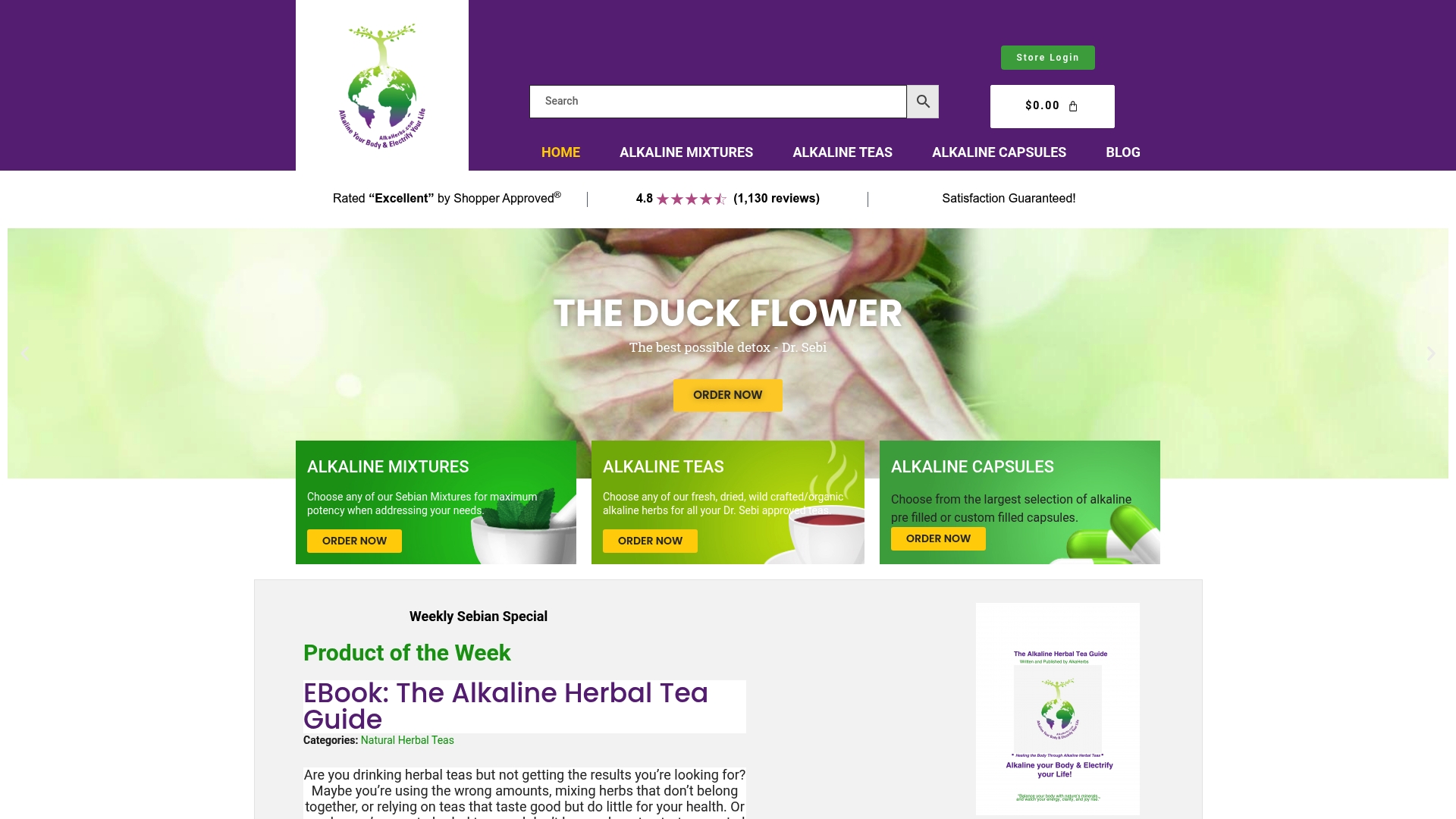
Alkaherbs builds its alkaline herbs catalog around exactly this standard, favoring wildcrafted and organic sourcing with documentation you can actually request. If you’re shopping specifically for detox or blood-cleansing support, the herbal detox collection groups blends built around that goal, and the alkaline herbal tea line gives you a lower-commitment starting point if you’re new to alkaline protocols. Browse the collection, check the product details for sourcing and batch information, and reach out if you want to see the testing behind a specific item before you order.
Where Can You Learn More About Herb Testing and Regulation?
For deeper reading on testing standards and regulatory context, start with the NCCIH’s guidance on natural products and safety, the AHPA GACP–GMP guidance on botanical identity, and the clinical review on herbal supplements and cGMP practice. For practical buying advice, see this guide to choosing a quality supplement and the supply-chain traceability report on sourcing best practices.
- Bookmark these sources before you shop, not after a purchase goes wrong.
- Cross-check any CoA you receive against the testing methods these sources describe.
Frequently Asked Questions
What is a herb quality grading system in simple terms?
It’s a way of ranking herbs based on how they were grown, whether their identity is confirmed, how potent they are, and whether independent testing has checked for contaminants.
Is a “GMP certified” label enough to trust a product?
No. GMP certification confirms a facility follows consistent manufacturing steps, but it doesn’t confirm the potency or purity of one specific batch. Ask for a CoA too.
What’s the fastest way to check if a seller’s grading claims are real?
Ask for a batch-specific CoA naming the testing lab and date. If they can’t produce one quickly, treat that as a red flag.
Do alkaline or detox herbs need different testing than other herbs?
The core criteria stay the same, but contaminant screening for heavy metals matters more, since some detox botanicals concentrate metals from soil more readily than others.
Should I talk to a doctor before starting an herbal detox protocol?
Yes, especially if you take medication or manage a chronic condition. Natural doesn’t automatically mean safe for every body or every combination of ingredients.
This article is general information, not a substitute for advice from a qualified doctor. Consult a qualified healthcare professional about your own circumstances before acting on anything here.
Sources
- Natural doesn’t mean better | NCCIH
- Clinical Implications of Herbal Supplements in Conventional Medical Practice: A US Perspective – PMC
- AHPA GACP–GMP guidance: Section 2 — Botanical identity & quality
- How to Choose a Quality Supplement: Testing
- Untitled design