

How to Test Body pH at Home: Saliva and Urine Guide
You can monitor your body pH at home using saliva or urine pH test strips, available over the counter at most pharmacies. These strips are wellness-monitoring tools, not diagnostic tests. They cannot tell you your blood pH or diagnose a medical condition, but they can reveal patterns in how your body is processing waste and maintaining its internal environment over time.
Here is what to know before you start:
- Use saliva strips to track your oral environment and a rough proxy for systemic acid-alkaline balance.
- Use urine strips to monitor how your kidneys are excreting metabolic acids and bases.
- Test under consistent conditions — same time of day, same pre-test behaviors — so readings are comparable.
- Track trends over 30 days, not individual readings. A single number tells you almost nothing useful.
According to MedlinePlus, the typical clinical reference range for urine pH runs from 4.6 to 8.0, measured via a color-sensitive dipstick on a fresh sample. Saliva pH tends to run slightly higher, generally around neutral levels under normal conditions, though this varies with diet and time of day. The pH scale itself runs from 0 to 14 and is logarithmic, meaning each whole number represents a tenfold change in acidity or alkalinity.
Key Takeaways
At-home pH testing with saliva or urine strips is a practical wellness-monitoring tool when used consistently over 30 days, interpreted as trends rather than single readings, and kept clearly separate from clinical diagnosis.
| Point | Details |
|---|---|
| Use the right strips | Choose dual-pad strips with 0.5 pH increments rated for saliva and urine, not universal litmus paper. |
| Timing is everything | Test saliva 2+ hours after eating; compare first and second morning urine for a reliable baseline. |
| Normal urine range: 4.6–8.0 | Readings outside this range on multiple consecutive days warrant a clinician visit. |
| Track trends, not single readings | A 30-day log reveals diet and lifestyle patterns that one number never can. |
| Alkaherbs herbal support | Alkaherbs alkaline herbal teas and herbs are a dietary complement some readers use alongside pH tracking. |
Table of Contents
- How to test body pH: what you need before you start
- When is the best time to test saliva vs. urine?
- How to test saliva pH step by step
- How to test urine pH step by step
- How do you read pH strip colors and what do the numbers mean?
- How accurate are at-home pH strips, and when do results not apply?
- What changes your pH readings, and how do you get consistent results?
- How do you choose the right pH test strips?
- How to track your readings and decide what to do next
- What consistent monitoring actually taught me
- Alkaherbs herbal teas and alkaline herbs for your pH-tracking plan
- Sources
How to test body pH: what you need before you start
Gather these before your first test. Missing one item usually means a compromised reading.
Essential items:
- pH test strips rated for saliva and urine (look for multi-pad strips with 0.5 pH increments)
- A clean, dry collection cup if you plan to collect urine rather than dip mid-stream
- A timer or watch
- A logbook or a simple notes app on your phone
- The color chart that came with your strips (do not substitute a generic chart from another brand)
Alkaherbs carries saliva/urine pH test strips designed for at-home monitoring, with clear dual-pad indicators and a color chart calibrated for both sample types.
Optional upgrades:
- A digital pH meter for more precise numeric readings. These require calibration with buffer solution before each session and careful probe maintenance, but they outperform strips when accuracy matters.
- Distilled water for rinsing the meter probe between readings.
Pro Tip: Choose strips with a narrow pH interval — 0.5 pH increments rather than whole-number jumps. Strips with 1.0-unit resolution will miss meaningful shifts in your trend data.
When is the best time to test saliva vs. urine?
Timing is where most people go wrong. The same person can read pH 5.5 at 7 AM and pH 7.2 at noon, and both readings are accurate for that moment. Without consistent timing, your log is just noise.
For saliva:
- Test mid-morning, at least 2 hours after eating, drinking anything other than water, or brushing your teeth.
- Avoid first-morning saliva as your primary data point. Overnight mouth bacteria produce acids that skew the reading acidic regardless of your systemic state.
- If you want to test first thing in the morning, note it separately and do not mix it with your mid-morning readings.
For urine:
- First-morning urine is typically the most acidic because your kidneys concentrate overnight metabolic waste. It is useful as a baseline but not representative of your daytime state.
- Many practitioners recommend comparing first and second morning urine, or using a consistent mid-morning sample as your primary tracking reading.
- Wait at least 2 hours after a large meal before testing urine for a more stable reading.
A simple testing schedule for a 30-day tracking period:
- Wake up. Collect first-morning urine, test immediately, log it.
- Eat breakfast. Wait 2 hours.
- Collect second urine sample or test saliva mid-morning. Log it.
- Repeat at the same times daily or every other day.
- At the end of each week, review the pattern, not the individual numbers.
Peer-reviewed research confirms that urine pH fluctuates with diet, medications, metabolic activity, and time of day, which is exactly why single readings mislead and trend data informs.
How to test saliva pH step by step
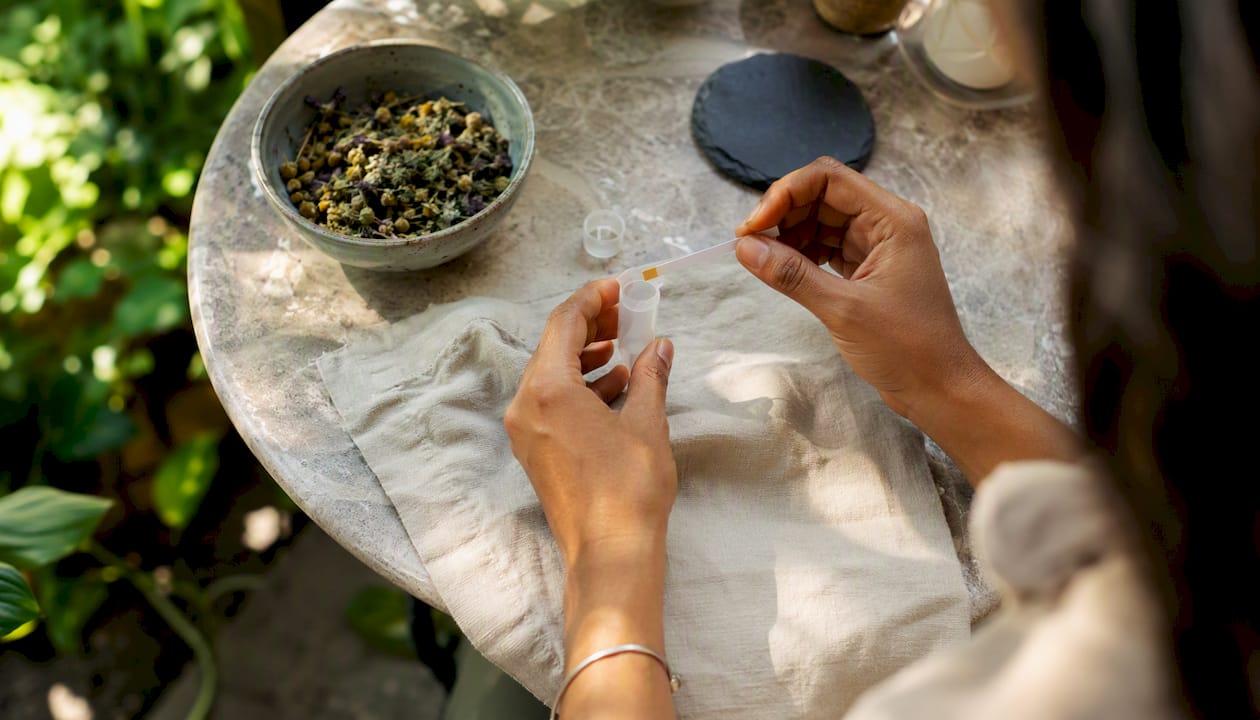
The single most important rule: wait at least 2 hours after eating, drinking, or brushing before collecting unstimulated saliva. Testing too soon means you are measuring what you just ate, not your baseline.
Step-by-step:
- Wash your hands thoroughly.
- Fill your mouth with saliva, then swallow to clear any residue from your mouth.
- Wait 30 seconds, then let fresh saliva pool under your tongue without stimulating it by chewing or thinking about food.
- Place the pH strip directly on your tongue or collect a small amount of saliva in a clean spoon and dip the strip into it.
- Hold the strip in the saliva for the time specified by the manufacturer (usually 1–2 seconds).
- Remove the strip and lay it flat. Do not shake it.
- Wait the full color-development time shown on the packaging (typically 15–60 seconds). Read it against the color chart in natural light.
- Record the numeric pH value, the time, and any relevant notes (what you ate, stress level, medications taken).
Common errors to avoid:
- Rinsing your mouth with water right before testing. Water changes the oral pH temporarily.
- Testing with frothy or bubbly saliva. Bubbles interfere with pad contact. Swallow and wait again.
- Reading the strip under yellow artificial light. Colors shift under warm bulbs; use daylight or a white LED.
- Waiting too long to read. Most strips begin to change color after 60 seconds and will give a false reading.
SimplexHealth’s protocol recommends testing both saliva and urine under consistent conditions and tracking over a 30-day period for meaningful trend data.
How to test urine pH step by step
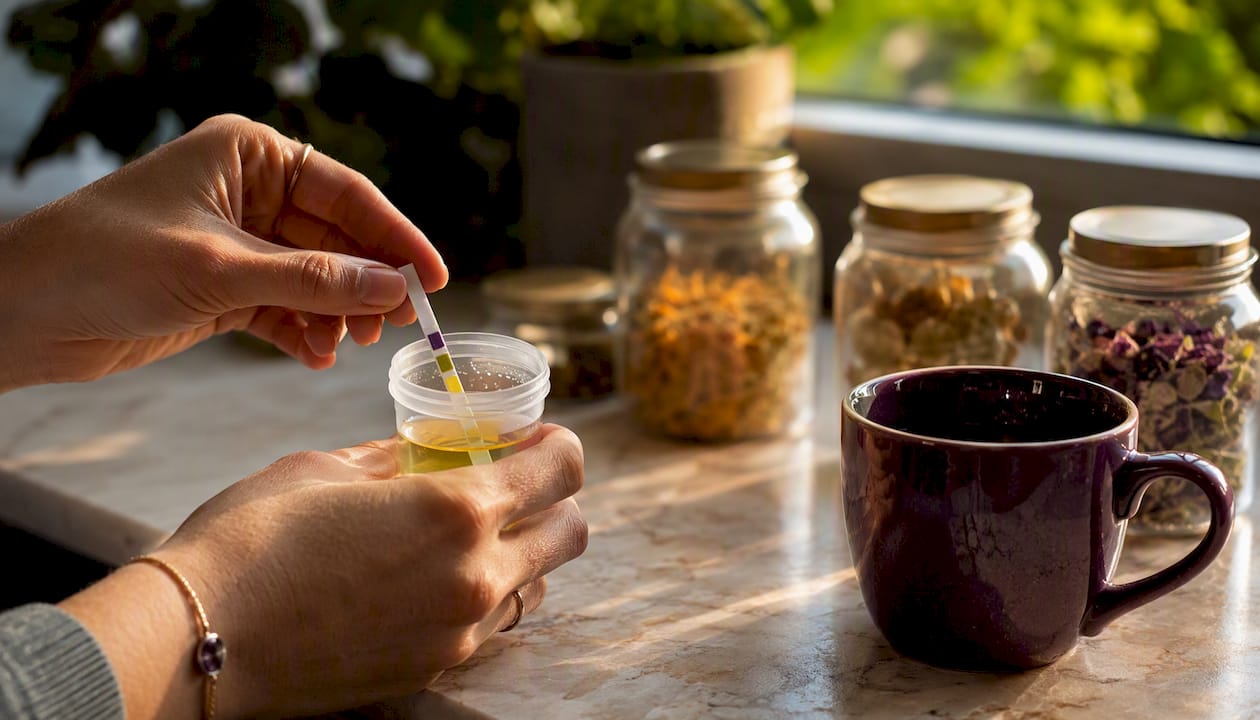
Use midstream urine or a freshly collected sample. Test it promptly — pH shifts as urine sits exposed to air.
Step-by-step:
- Wash your hands. If collecting in a cup, use a clean, dry container with no soap residue.
- Begin urinating. Let the first few seconds pass (the midstream method avoids contamination from the urethra).
- Either hold the strip directly in the urine stream for 1–2 seconds, or collect a small amount in the cup and dip the strip.
- Remove the strip and shake off the excess gently.
- Lay the strip flat and wait the manufacturer-specified time (usually 15–60 seconds).
- Read both pads against the color chart in natural light. If contaminants affect the lower pad, use the top pad reading.
- Log the result immediately: date, time, pH value, sample type (first morning, second morning, mid-morning), and any notes.
Pro Tip: Test the sample within 5 minutes of collection. Mayo Clinic Laboratories notes that exposure to air and delayed testing can change pH readings, even at room temperature.
Mistakes that ruin urine readings:
- Using a container rinsed with soap or disinfectant. Chemical residue alters pH immediately.
- Testing old strips. Expired or improperly stored strips give unreliable color development.
- Waiting more than a few minutes to read the strip after dipping. Colors continue to develop and will no longer match the chart.
- Mixing first-morning and mid-morning samples in the same data set without labeling them separately.
How do you read pH strip colors and what do the numbers mean?
Match the color on each pad to the chart that came with your specific strips. Different brands use different dye formulations, so a generic chart from another product will give you the wrong number.
If your strip has two pads, read both and average them, or use the top pad if the lower one looks contaminated. Record the number, not just a color description.
| pH Range | Classification | What it may suggest for wellness monitoring |
|---|---|---|
| Below 5.5 | Strongly acidic | Common in first-morning urine; may reflect high protein intake, dehydration, or metabolic load |
| 5.5–8.0 | Mildly acidic | Typical daytime urine range for many people on a standard diet |
| — | Near neutral | Often associated with balanced dietary intake |
| — | Mildly alkaline | Common after plant-rich meals; typical saliva range |
| Above 8.0 | Alkaline | Can reflect high vegetable/fruit intake, certain medications, or UTI in urine |
A few important interpretation points:
- One acidic reading does not mean your body is “too acidic.” Your blood pH is tightly regulated between 7.35 and 7.45 regardless of what your urine or saliva shows.
- Clinical and open-access literature makes clear that saliva and urine pH measure fluid compartments, not systemic blood pH. They are proxies for metabolic activity, not direct measures of your body’s acid-base status.
- A consistent pattern of readings below 5.5 across multiple days is more meaningful than a single low reading after a high-protein meal.
For a deeper look at why alkaline pH benefits the body, the relationship between dietary choices and pH trends is worth understanding before you start interpreting your numbers.
How accurate are at-home pH strips, and when do results not apply?
Home pH strips are useful for spotting trends. They are not precise instruments.
At-home saliva and urine pH strips typically read within 0.5–1.0 pH units of a calibrated lab measurement under ideal conditions. Real-world accuracy is lower when strips are old, improperly stored, or read under poor lighting. Use them to track direction and patterns, not to make clinical decisions. UCSF Health notes that even lab dipstick results can vary between facilities and emphasizes that specimen handling and timing affect interpretation.
Factors that make a single reading unreliable:
- Recent high-protein or high-sugar meal
- Dehydration or excessive water intake
- Prescription medications (diuretics, antacids, antibiotics)
- Urinary tract infection (UTI) — bacteria alter urine pH directly
- Kidney disease or metabolic disorders
- Strips past their expiration date or stored in a humid bathroom cabinet
When to stop self-monitoring and see a clinician:
- Urine pH consistently below 4.6 or above 8.0 across multiple readings
- Burning, urgency, or cloudy urine alongside abnormal pH readings (possible UTI)
- Persistent flank pain or blood in urine (possible kidney stones or other conditions)
- Any symptom that does not resolve within a few days, regardless of what your strips show
Home testing is a monitoring tool. It is not a substitute for a urinalysis, blood gas test, or clinical evaluation.
What changes your pH readings, and how do you get consistent results?
Major influencers on pH readings:
- Diet: High-protein meals push urine acidic; fruit and vegetable-heavy meals push it alkaline.
- Hydration: Concentrated urine reads more acidic; dilute urine reads more alkaline.
- Exercise: Intense exercise temporarily acidifies urine as lactic acid is cleared.
- Stress: Elevated cortisol can affect kidney acid excretion.
- Medications: Antacids, diuretics, and some antibiotics shift both saliva and urine pH.
- Oral hygiene: Toothpaste and mouthwash temporarily alkalinize saliva. Wait at least 30 minutes after brushing before testing saliva.
- Kidney function: The kidneys are the primary regulators of urine pH; any impairment changes baseline readings.
Practical tips for repeatable readings:
- Test at the same time every day.
- Follow the same pre-test routine (no food or drink for 2 hours before saliva testing).
- Store strips in a cool, dry place — not the bathroom. Humidity degrades the chemical pads faster than anything else.
- Keep strips in their original sealed container with the desiccant packet inside.
- Replace strips that show color development before dipping (a sign of moisture damage).
Pro Tip: If your readings are wildly inconsistent week to week, check your strip storage first. A container left open near a sink is often the culprit, not your diet.
For higher precision, a calibrated digital pH meter is worth considering, but only if you are willing to calibrate it with buffer solution before each session and clean the probe properly between uses.
How do you choose the right pH test strips?
Not all strips are equal. Here is what the specifications actually mean:
Buying checklist:
- pH range: Choose strips covering at least pH 4.0–9.0 for body fluid monitoring. Strips rated 0–14 are for industrial use and have poor resolution in the physiological range.
- Resolution: 0.5 pH increments are the minimum for useful wellness tracking. Whole-number strips miss too much.
- Pad type: Dual-pad strips cross-reference two dyes for better accuracy. Single-pad strips are fine for a rough check.
- Instructions: Clear, printed color charts included in the package. If the chart is only available online, the colors may not match your screen calibration.
- Shelf life: Check the expiration date. Most strips last 12–24 months sealed; far less once opened.
- Third-party validation: Some manufacturers include lab-comparison data. This is a bonus, not a requirement, but it signals quality control.
Where to buy:
- Pharmacies (CVS, Walgreens, Rite Aid) — typically stock basic urine dipstick strips; saliva-specific strips are less common in-store.
- Reputable online retailers — wider selection, including dual-pad saliva/urine strips.
- Specialty wellness retailers like Alkaherbs — strips designed specifically for the saliva/urine wellness-monitoring use case.
Search terms that work: “saliva urine pH test strips 0.5 resolution,” “dual pad pH strips body fluid,” “pH strips 4.5–9.0 range.”
Avoid strips marketed as “universal pH paper” or “litmus paper.” These are designed for chemistry labs, not body fluid monitoring, and their color charts do not align with physiological ranges. Natural plant-based indicators like red cabbage extract are used in educational lab settings but are not reliable for personal health monitoring — extraction procedures and color stability make them unsuitable for consistent home use.
How to track your readings and decide what to do next
A single pH reading is a data point. Thirty days of readings is a picture.
Simple tracking template:
Keep this log in a notebook or a spreadsheet. After 30 days, look for:
- A consistent direction: Are readings trending more acidic or more alkaline over the month?
- Outliers: Single readings that spike or drop sharply usually reflect a meal, medication, or illness, not a systemic shift.
- Stable patterns: If urine pH stays below 5.5 most mornings for three or more weeks, that is worth discussing with a clinician.
Lifestyle adjustments worth trying if readings trend acidic:
- Increase leafy greens, cucumbers, and citrus fruits.
- Reduce processed foods and excess animal protein.
- Improve hydration — aim for pale yellow urine as a basic hydration check.
- Reduce alcohol and caffeine, both of which push urine acidic.
When to bring your log to a clinician:
- Persistent readings outside the 4.6–8.0 urine range across multiple days
- Any physical symptoms alongside abnormal readings
- Readings that do not shift despite dietary changes over 2–3 weeks
- You are on medications that affect kidney function or acid-base balance
Bring your full log: dates, times, sample types, pH values, and your notes. A clinician can order a proper urinalysis or blood panel to investigate further.
What consistent monitoring actually taught me
The most underrated thing about at-home pH testing is not what a single reading reveals. It is what a month of readings reveals about your habits. Most people are surprised to find that their urine pH is consistently low on days they eat more animal protein and higher on days they eat more plants — not because the strips are diagnosing anything, but because the pattern is visible for the first time.
The strips are cheap, the protocol is simple, and the data is yours. The mistake is treating any one number as a verdict. Used as a trend tool, this kind of monitoring gives you a feedback loop that most people never have access to without a lab visit. That is genuinely useful, as long as you stay clear on what it is: a wellness signal, not a diagnosis.
Alkaherbs herbal teas and alkaline herbs for your pH-tracking plan
Alkaherbs offers a range of alkaline herbal teas and alkaline herbs that some customers incorporate alongside their pH-monitoring routines as part of a plant-forward dietary approach. These are not treatments for any medical condition, and they are not substitutes for clinical care. They are dietary options that fit naturally into the kind of lifestyle adjustments that often accompany consistent pH tracking.

If your 30-day log is showing a trend you want to address through diet, Alkaherbs’s organic, non-GMO herbal blends, including wildcrafted options inspired by Dr. Sebi’s alkaline approach, give you a concrete starting point. Browse the full range at Alkaherbs and consider pairing a herbal tea with your morning tracking routine.
This article is for general informational purposes only and is not a substitute for professional medical advice. Consult a qualified clinician for any health concerns or before making changes based on at-home pH readings.
Sources
- Urine pH – MedlinePlus
- Urine pH test – UCSF Health
- pH, Body Fluid – Mayo Clinic Laboratories
- NCBI Bookshelf (pH and physiology)
- PubMed article on urine pH variability
- How to test your pH using pH Test Strips – SimplexHealth
- How to Use a Digital pH Meter to Test Body pH | LEAFtv
- PMC article on acid-base balance