
Iodine in Sea Moss: Thyroid Risks When Portions Deliver 62,400 µg
Yes, sea moss contains iodine, and its iodine content is highly variable. A single serving can be harmless, or in some products, large enough to exceed the safe upper limit. That’s the honest verdict: this isn’t a supplement you take on autopilot. If you have thyroid disease, are pregnant, or take thyroid medication, talk to a clinician before adding it to your routine. For everyone else, start small, read labels carefully, and consider a baseline thyroid test before making sea moss a daily habit.
TL;DR:
- Certain sea moss products can deliver iodine amounts well above the safe upper limit, especially if they contain brown kelp or are untested blends.
- The iodine content in sea moss varies widely depending on species, harvest location, season, and processing, complicating accurate dosing for consumers.
- People with thyroid disease, pregnant women, infants, and those on thyroid medication should consult a clinician before using sea moss due to potential thyroid risks.
- Labeling often omits species and iodine levels, making it crucial to choose products with transparent testing and clear sourcing information.
- Starting with small doses, tracking iodine intake, and verifying lab testing can help mitigate the risk of thyroid imbalance linked to excessive iodine from sea moss.
Table of Contents
- Why Sea Moss Iodine Content Is So Unpredictable
- How Much Iodine Is Actually in Sea Moss?
- Iodine, the Thyroid, and Where Things Go Wrong
- Who Should Avoid Sea Moss or Talk to a Doctor First
- A Practical Safety Checklist for Buying and Using Sea Moss
- How Alkaherbs Approaches Sourcing and Testing
- Balancing Sea Moss Benefits With Medical Caution
- Try Sea Moss With Species-Declared Transparency
- Sources
Why Sea Moss Iodine Content Is So Unpredictable
Sea moss isn’t one uniform product, and that’s the root of the confusion. The term covers different species harvested from different waters and processed in different ways, so two jars labeled “sea moss” can carry wildly different iodine loads.
- Species differences: Red seaweeds like Chondrus crispus (Irish moss) carry different iodine concentrations than brown kelps such as kombu or sugar kelp, which tend to run much higher.
- Water source: Iodine levels in seawater vary by region, and pollution or heavy-metal exposure in coastal waters adds another layer of risk since sea moss can accumulate heavy metals from where it grows.
- Harvest timing: Seasonal shifts change mineral uptake in the plant itself.
- Processing and drying: Dehydration and storage methods can concentrate or dilute the final iodine content.
- Blended products: Many commercial blends don’t declare species at all, which makes the iodine content in seaweed products essentially a guessing game for the buyer.
How Much Iodine Is Actually in Sea Moss?
Published figures paint a scattered picture, and that scatter is the whole point. Researchers analyzing red seaweed samples found Irish moss (Chondrus crispus) averaged 3.86 ± 1.49 mg/kg dry weight, and a 4 gram daily serving of dehydrated Irish moss contributed roughly 25.7% of a child’s iodine dietary reference intake in that sample set. That’s a meaningful but manageable dose for most adults.
Commercial products tell a different story. A review of macroalgae supplements and foods found per-portion iodine values ranging from 128 to 62,400 micrograms, with several products delivering doses well above the tolerable upper intake level.
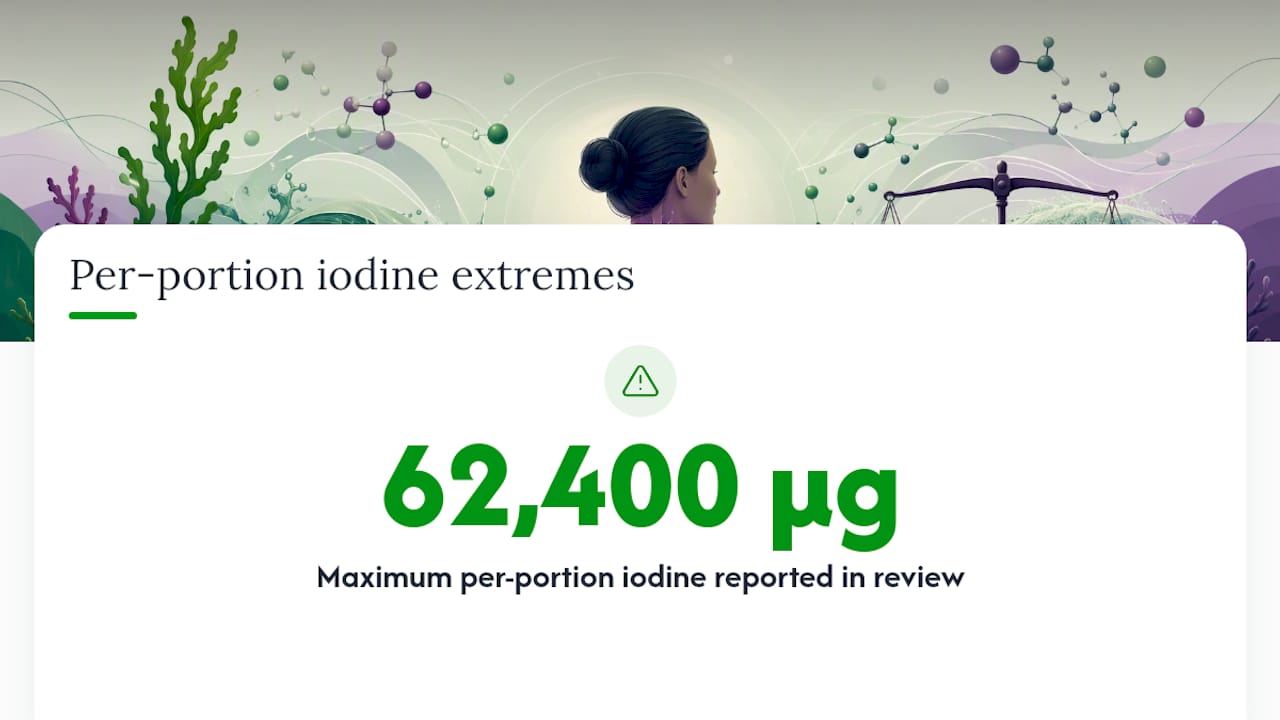
A single high-dose seaweed product can deliver much more than the daily tolerable upper limit for iodine in one serving, sometimes many times over. That’s the statistic that should make anyone shopping for sea moss stop and check a label before scooping a spoonful into a smoothie. Because labeling for these products often skips species names or iodine amounts entirely, exact dosing without lab testing is close to impossible.
Iodine, the Thyroid, and Where Things Go Wrong
Your thyroid needs iodine to build T4 and T3, the hormones that regulate metabolism, energy, and temperature. The NIH Office of Dietary Supplements sets the adult RDA at roughly 150 micrograms a day, with a tolerable upper intake level of 1,100 micrograms daily. Stay under that ceiling and iodine works the way it’s supposed to. Cross it repeatedly, and the story changes.
Where sea moss helps:
- Correcting a genuine iodine deficiency, which still affects some diets low in seafood, dairy, and iodized salt
- Supporting normal thyroid hormone production when intake has been consistently low
Where sea moss creates risk:
- Triggering hyperthyroidism through a mechanism called Jod-Basedow phenomenon, where a sudden iodine surge unmasks or activates autonomous thyroid tissue that was previously quiet
- Pushing susceptible people toward hypothyroidism, since paradoxically, excess iodine can also suppress thyroid function
- Flaring autoimmune thyroid conditions like Hashimoto’s or Graves’ disease in people who already carry the antibodies
Pro Tip: If you notice a racing heart, unexplained weight change, or new neck swelling after starting sea moss, stop use and get your thyroid panel checked. Those are classic signs your iodine intake outpaced what your thyroid can handle.
Endocrinologists generally advise against unsupervised iodine supplementation for exactly this reason. Most diets in iodine-replete countries already meet the RDA through ordinary food, so the case for a heavy sea moss habit is weaker than marketing suggests.
Who Should Avoid Sea Moss or Talk to a Doctor First
Some groups face real risk from iodine swings, and skipping medical guidance isn’t worth the gamble.
- People with existing thyroid disease. Hashimoto’s, Graves’ disease, or thyroid nodules can react unpredictably to sudden iodine loads, sometimes triggering thyrotoxicosis in people who seemed stable.
- Pregnant and breastfeeding people. Iodine needs shift during pregnancy, and both deficiency and excess carry risks to fetal thyroid development.
- Infants and young children. Their smaller body mass means the same dose that’s mild for an adult can represent a much larger relative exposure.
- Anyone on levothyroxine or antithyroid medication. Sea moss can shift lab values enough to throw off a carefully calibrated dose, so monitoring symptoms matters if you’re on thyroid medication and want to try it.
For anyone in these categories, a baseline TSH and free T4 test before starting, followed by a recheck at 6 to 8 weeks, gives a clinician real data instead of guesswork. Urinary iodine testing exists too, but it needs clinical interpretation, not a home test kit.
A Practical Safety Checklist for Buying and Using Sea Moss
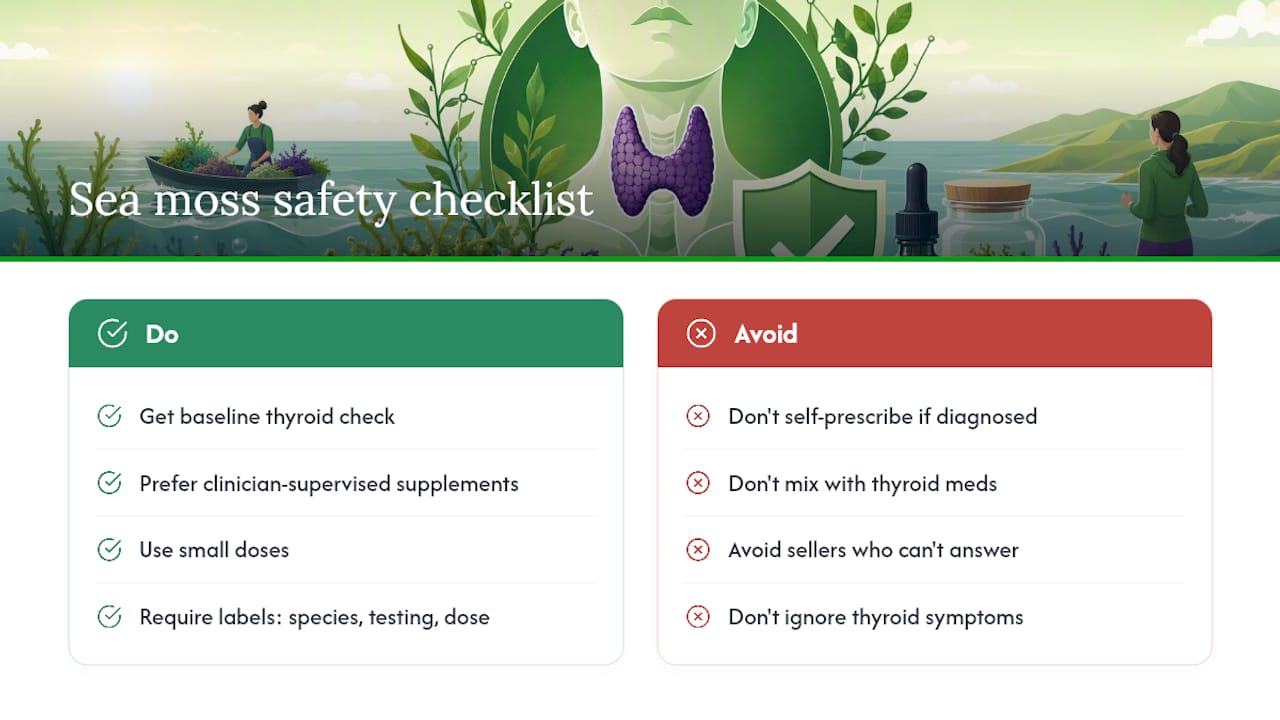
Before you buy, check three things: species, testing, and dose guidance. Labels that skip all three are a red flag.
- Read for the Latin name. “Chondrus crispus” or “Gracilaria” tells you more than a generic “sea moss” label ever will.
- Look for batch testing. Reputable sellers publish heavy-metal and iodine testing results, not just marketing copy.
- Start low. Try a partial serving for the first week rather than the full recommended dose.
- Track total iodine intake. Don’t stack sea moss with iodized salt, dairy, or other seaweed supplements without adding up the total.
- Ask about provenance. Clean-water harvest sites matter since sea moss absorbs whatever is in the water around it.
Pro Tip: Keep a simple log for your first month: date, serving size, and how you feel. If you’re also tracking supplements for other goals, a resource like this heart health supplement guide offers a useful framework for building safe habits around any new addition to your routine.
How Alkaherbs Approaches Sourcing and Testing
Alkaherbs builds its sea moss line around the transparency this category badly needs. Species declaration isn’t an afterthought here.
- Product pages name the species directly, such as the Chondrus crispus in the Honduras sea moss gel, so you know exactly what you’re buying instead of guessing from a vague label.
- Dosing guidance accompanies each product listing, with clear direction to consult a clinician if you fall into a higher-risk category.
- Formulations range from raw gel to concentrated capsules, which matters because concentrated forms need more careful dosing than a diluted gel.
- Product specs and sourcing details sit on the site for anyone who wants to check before buying, not after.
That kind of upfront detail is what separates a responsibly labeled product from the anonymous blends driving most of the risk numbers cited earlier.
Balancing Sea Moss Benefits With Medical Caution
Sea moss can genuinely help someone with a mild iodine gap, and it can genuinely hurt someone with undiagnosed thyroid nodules or an autoimmune flare waiting to happen. Both things are true, and pretending otherwise does readers a disservice. The conservative path, small doses, transparent labels, and a baseline thyroid check, protects the people most likely to be harmed without denying the rest of us a mineral-rich food that’s been used for generations.
I lean toward recommending clinically supervised supplementation over guesswork whenever someone already has a thyroid diagnosis or takes thyroid medication. For everyone else, product transparency is the deciding factor: know the species, know the testing, know the dose. If a seller can’t answer those three questions, that’s your answer about whether to buy from them.
— Alka
Try Sea Moss With Species-Declared Transparency
Most sea moss on the market gives you a vague label and a hope that it works out. Alkaherbs takes the opposite approach: every listing names the species, so you’re never left guessing whether you bought Irish moss or an unlabeled kelp blend that could carry a very different iodine load.
The Purple Sea Moss and Honduras-sourced Chondrus crispus gel both come with clear sourcing details and dosing guidance built into the product page, so you can start conservatively and adjust with real information instead of guesswork. If you’re managing a thyroid condition or taking medication, read the guidance on the page first and check with your doctor before adding it to your routine. Ready to see what a transparently sourced sea moss product looks like? Browse the alkaline herbs collection and start with a small serving size.
This article is general information, not a substitute for advice from a qualified doctor. Consult a qualified healthcare professional about your own circumstances before acting on anything here.
Sources
- Commercially available kelp and seaweed products – valuable iodine source or risk of excess intake? – PMC
- Risk assessment of iodine intake from the consumption of red seaweeds (Palmaria palmata and Chondrus crispus)
- Iodine — Office of Dietary Supplements (NIH)
- Health benefits of sea moss (Cleveland Clinic)